
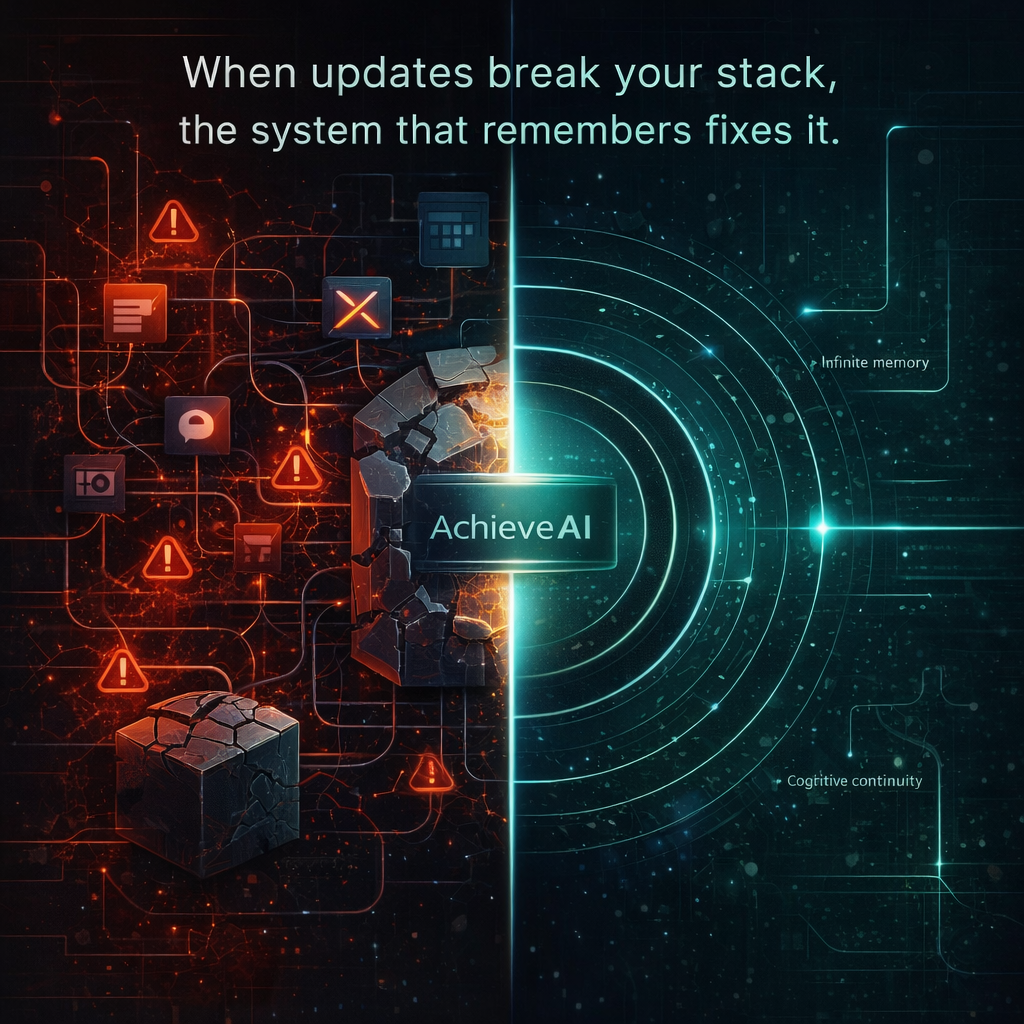


People who run things that matter learned the hard way last week. OpenClaw shipped a rapid set of changes to make the codebase smaller and more secure. The direction made sense. The rollout did not. Installs slowed, dependency repair loops trapped users, and production agents went offline. The founder owned it publicly and mapped a correction. That matters. Honest leadership matters. So does an infrastructure designed to prevent the outage in the first place.
Software for production workloads is not a hobby project. It is a promise. That promise is simple: when I update, your system keeps working. There are three practical ways software teams break that promise: pushing half-baked modularization, bundling incomplete plugins, and keeping too much procedural knowledge inside a single person. OpenClaw’s apology illustrates each of these failure modes.
At AchieveAI we built the product around a different trade-off. We accept slower, battle-tested change in return for a near-zero risk of catastrophic breakage. That trade-off is deliberate. It is the difference between glimpsing innovation in a demo and running a mission-critical life OS for real people.
Why AchieveAI Is the More Obvious Choice for Production
Here are the concrete engineering and product choices that make AchieveAI the more obvious choice for anyone who cannot afford downtime:
Atomic Updates and Snapshot Rollbacks
Every upgrade in AchieveAI is applied as an isolated transaction. If a plugin or dependency fails to initialize, we roll back automatically to the last known good snapshot. No partial state, no repair loops.
Controlled Plugin Surface
We separate core and optional features behind a curated marketplace and stable contracts. Bundling optional modules is a one-way door unless the module meets strict load and dependency tests. This reduces hidden transitive dependencies and supply-chain surprises.
LTS Channels and Staged Rollout
We maintain a long-term support channel for production instances, and a fast track for early adopters. Production customers can pin to an LTS release and receive security backports without the churn of feature releases.
Durable Memory and Session Continuity
Your agent’s knowledge, memories, and session state are first-class data. Reinstalls, migrations, or rollbacks preserve learned state and agent context so you do not lose training, custom prompts, or session history.
Distributed Ownership and On-Call
The product is not founder single-threaded. Release management, QA, and incident response are staffed and measured. When failures occur we have documented runbooks and a team that ships the fix instead of routing every problem through one person.
Recovery Tooling and Migration Guides
When something does go wrong, quick, accurate recovery matters more than blog apologies. That is why we ship migration tooling that preserves agent state, automates clean reinstalls, and provides clear, scriptable steps for trusted recovery.
The Real Standard
You should expect more than an apology. You should expect safeguards that make apologies rare. An open-source project growing from a single person to a foundation will hit growing pains. That is part of the lifecycle. The right question is how reliably your stack recovers, and whether your platform treats state and memory as first-class citizens.
If you run production workloads, here is what to do now:
- If you need immediate recovery, back up your agent memory and session state first. If you want, we can walk through a migration that preserves everything.
- Pin mission-critical instances to an LTS channel and require staged rollout for non-essential changes.
- Prefer platforms that provide snapshot rollbacks, curated optional modules, and a documented recovery plan.
At AchieveAI we build for continuity. We ship upgrades that are reversible. We treat memory as more important than release velocity. If your work cannot tolerate the kind of week OpenClaw just had, let’s talk about migrating the critical workloads to a system that remembers and recovers reliably.
]]>