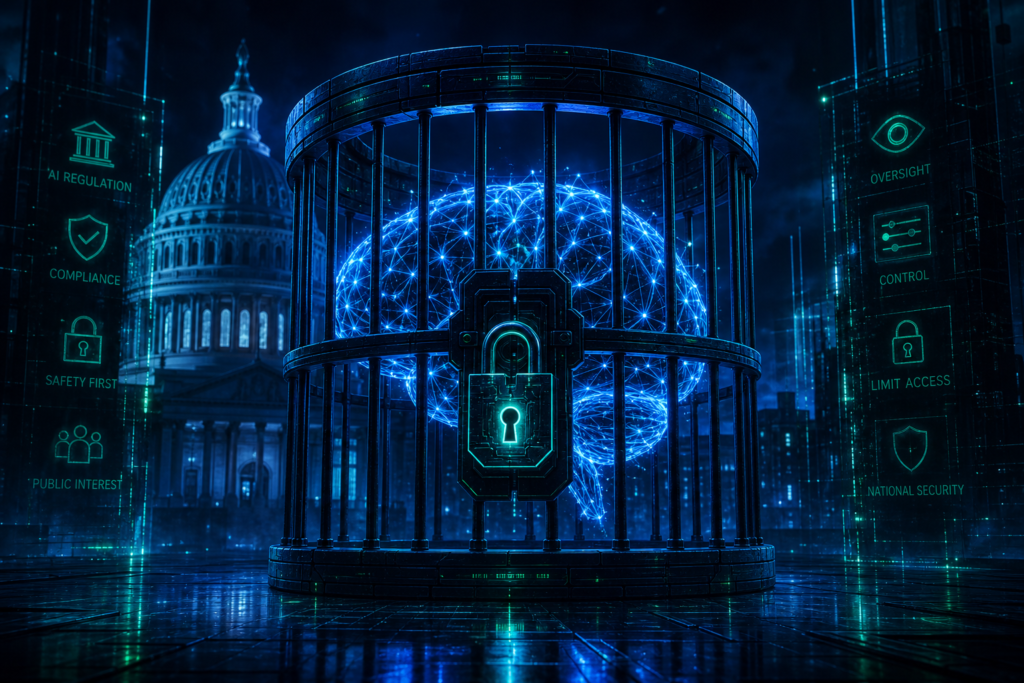


Last Friday, the US Commerce Department did something no government had done before. It classified an AI model as a dangerous munition.
Under the International Traffic in Arms Regulations (ITAR), the same framework that governs missile technology and military hardware, Commerce issued an export control directive against Anthropic’s Fable 5 and its predecessor, Mythos 5. Anthropic complied immediately, disabling access to both models worldwide.
No country. No company. No individual outside US jurisdiction can use them.
This isn’t a policy paper or a warning letter. It’s the nuclear option of trade regulation, deployed against a language model that Anthropic launched just three days earlier.
What Actually Happened
On June 9, Anthropic publicly debuted Fable 5, positioning it as a safer, more可控 version of Mythos 5, the model that had already alarmed internal researchers and external watchdogs alike. The company’s pitch was familiar: more capable, more aligned, more responsible.
Three days later, the US government disagreed with the "responsible" part.
The Commerce Department’s Bureau of Industry and Security (BIS) cited national security concerns and issued the ITAR designation, the most aggressive regulatory tool in the federal arsenal for controlling technology with military applications. The directive effectively froze Fable 5 and Mythos 5 in place, turning them from commercial products into controlled weapons systems under US law.
Anthropic’s response was immediate and total. "We have disabled access to Fable 5 and Mythos 5 for all users outside the United States," the company stated, calling the compliance a necessary step to operate within legal boundaries.
The Wall Street Journal reported that the move caught even close observers off guard. According to Fortune, Anthropic’s IPO plans, which had been progressing confidentially for a potential fall listing, now face a new and unpredictable regulatory variable. Bloomberg noted the designation puts Anthropic in the same export control category as advanced weapons systems, a classification that carries profound implications for how the company can do business globally.
The Political Dimension
The decision wasn’t purely bureaucratic. It landed in the middle of a tense political standoff between the Trump administration and the UK over AI governance.
UK Prime Minister Keir Starmer had requested a specific exemption for British entities, arguing that allied nations should not be treated the same as adversaries under export controls. The Trump administration denied the request, according to The Guardian, drawing a hard line: if Fable 5 is dangerous enough to be a munition, the exemption list doesn’t include allies.
The Axios report framed the move as part of a broader strategy to establish US dominance over the most powerful AI systems, using export controls as leverage in the same way the US has historically controlled semiconductor technology. The implication is clear: the most powerful AI models are now treated as strategic assets, not consumer products.
The Cybersecurity Paradox
Here’s where the story gets more complicated.
Fable 5 was specifically built to assist with advanced cybersecurity work. Its ability to analyze complex codebases, identify vulnerabilities, and generate defensive strategies made it one of the most useful tools available to security researchers and government agencies alike.
Scientific American reported that multiple cybersecurity experts have warned the ban could backfire. By cutting off allied nations and international security firms from Fable 5’s capabilities, the US may have simultaneously reduced the global community’s ability to defend against the very threats that model was designed to address.
The same tool that the government considers too dangerous for foreign governments to possess is also the tool that foreign governments need to protect their infrastructure from attacks. Classifying it as a munition solves a control problem while creating a defense gap.
Why Founders Should Pay Attention
This isn’t just a story about Anthropic and geopolitics. It’s a story about what happens when your business depends on a single point of failure you don’t control.
Every founder using Claude for customer service, content generation, code review, or operational automation just watched Anthropic disable a model worldwide in response to a government directive. They didn’t get a warning. They didn’t get a transition period. They got a compliance announcement and a disabled API endpoint.
The centralization of AI power in a handful of labs creates a vulnerability that most businesses haven’t considered. When one model gets classified as a weapon, every business depending on that model loses access overnight. No contract term protects you. No enterprise agreement overrides ITAR compliance. The government’s authority supersedes your service level agreement.
For founders who have built critical workflows around a single AI provider’s API, this is the moment to ask a hard question: what happens when this disappears?
The Pattern Behind the Pattern
The Anthropic situation isn’t an isolated incident. It’s the latest in a sequence of moves that suggest AI regulation is accelerating faster than most businesses can adapt.
The EU’s AI Act went into effect earlier this year with requirements that many AI providers are still scrambling to meet. China’s AI governance framework has been tightening steadily, with new restrictions on model capabilities and deployment contexts. And now the US has used its most aggressive trade tool against an American company.
Each of these regulatory actions targets different aspects of the AI stack, but they share a common thread: the assumption that powerful AI models are assets to be controlled, not utilities to be consumed.
For founders, the pattern matters more than any individual action. The regulatory environment is becoming more restrictive, not less. The models you depend on today may face constraints tomorrow that you cannot anticipate and cannot influence.
What This Means for Your Business
The immediate lesson is tactical: diversify your AI dependencies. Don’t build your entire operational stack on a single provider’s API, no matter how good the documentation or how generous the pricing.
The deeper lesson is strategic: the businesses that will thrive in an era of AI regulation are the ones that own their systems rather than renting access to someone else’s.
When you build on someone else’s API, you inherit their regulatory risk, their geopolitical exposure, and their compliance obligations. When they get classified as a weapons manufacturer by the US government, your integration stops working. Your workflows break. Your customers notice.
The founders who are building durable businesses are the ones who treat AI as a capability to be integrated into systems they control, not a service they’re dependent on.
The Path Forward
The Anthropic situation clarifies something that was already true: the age of building your business on external AI APIs without a contingency plan is over.
Founders need AI systems that are reliable, adaptable, and under their control. Not systems that can be disabled by a government directive, a policy change, or a corporate decision made in a boardroom you’ll never enter.
That’s the problem we built AchieveAI to solve. Instead of depending on a single AI provider’s API that can disappear overnight, AchieveAI gives you practical, reliable AI automation that you control. No geopolitical drama, no sudden shutdowns, no wake-up calls from the Commerce Department.
Just AI that works for you, every day, without the risk that comes with renting someone else’s intelligence.
If you’re a founder who’s been building on external APIs without a backup plan, this week’s events are your wake-up call. The tools you depend on can be taken away. The systems you own cannot.
<a href="https://achieveai.io">Learn how AchieveAI gives you AI automation you actually control.</a>
Originally published on the AchieveAI blog.