
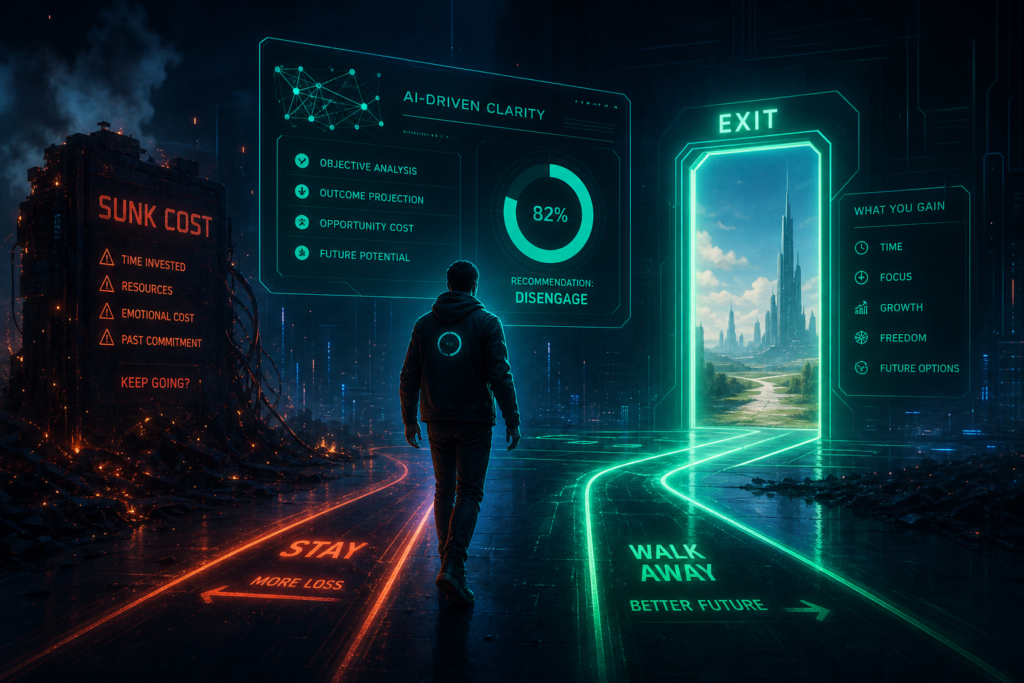


You spent eight months building a product no one asked for. You invested $40k in a marketing strategy that leaked money. You stayed in a business partnership long after the trust eroded.
Why? Because you "already put in so much."
That sentence has killed more companies, careers, and potential than any market crash. It’s the sunk cost fallacy, and it’s the single most expensive cognitive bias in business.
The good news: there’s a systematic way to cut through it. And AI just made that system brutally objective.
What the Sunk Cost Fallacy Actually Costs You
The sunk cost fallacy is simple to define and nearly impossible to escape in practice: you continue investing time, money, or energy into something because of what you’ve already invested, not because of what you’ll get going forward.
Every dollar spent is a sunk cost. Every hour gone is gone. The only rational question is: "If I started fresh today, would I make this same choice?"
But humans aren’t rational. We’re emotional accountants, and our books are cooked.
Here’s what it looks like in practice:
- The founder who keeps pouring runway into a product with declining users because "we’re so close."
- The operator who stays in a partnership that drains energy because "we’ve been through too much together."
- The entrepreneur who won’t pivot because admitting the current strategy is wrong means admitting they were wrong.
The sunk cost fallacy doesn’t just cost you money. It costs you the next opportunity you can’t see because you’re too busy propping up the last one.
Why Smart People Fall for It Harder
Here’s the brutal irony: the more intelligent you are, the better you are at rationalizing sunk costs.
Smart people build sophisticated justifications. They find data that supports continuing. They construct narratives where the breakthrough is just around the corner. They mistake their ability to argue for continuing with actual evidence for continuing.
This is why founder burnout isn’t just about workload. It’s about the cognitive load of maintaining a reality distortion field around a strategy that stopped working months ago.
You’re not tired from working hard. You’re tired from defending a position you privately know is wrong.
The AI Game-Changer: Objective Data Over Emotional Attachment
This is where artificial intelligence fundamentally changes the decision-making landscape.
Humans filter reality through emotion, ego, and narrative. AI filters reality through data. It doesn’t care about your origin story. It doesn’t care about the argument you had with your co-founder in 2023. It cares about trajectory, metrics, and probability.
AI decision making strips away the stories you tell yourself and replaces them with the numbers you’ve been avoiding.
Consider what an AI system can track that your gut cannot:
- Actual conversion rates over time, not the one good month you keep referencing.
- Customer acquisition cost trends, not the theoretical unit economics in your pitch deck.
- Time allocation analysis showing where your hours actually go versus where you think they go.
- Comparative opportunity cost: what else could this capital and energy produce?
The power isn’t that AI makes decisions for you. The power is that AI shows you the decision you already know you need to make but have been too emotionally invested to face.
When your Life OS tracks your actual progress against your stated goals, the gap between narrative and reality becomes impossible to ignore.
The Quit Filter: A Framework for Knowing When to Persist vs. When to Cut Losses
Knowing when to quit requires a systematic approach. Emotions can’t be trusted here. Here’s the Quit Filter, a four-part framework for making the call.
1. The "Fresh Start" Test
Ask yourself: If I had zero history with this project, relationship, or strategy, and someone presented me with the current state of affairs, would I start it today?
If the answer is no, you have your answer. The history is the only reason you’re still in it.
This isn’t theoretical. Sit down with the raw data of where you are right now. Revenue trajectory. User growth. Team morale. Personal energy levels. Would you sign up for this today?
2. The Trendline Check
One bad month isn’t a trend. But three months of decline is. AI excels here because it removes the cherry-picking humans do instinctively.
Build a decision dashboard that tracks leading indicators, not lagging vanity metrics. Leading indicators predict where you’re going. Lagging indicators tell you where you’ve been. You need the forecast, not the postmortem.
Specific metrics to watch:
– Month-over-month growth rate (or decline rate)
– Customer retention and churn trends
– Revenue per hour invested
– Energy cost: are you more or less depleted than 90 days ago?
If the trendline points down for three consecutive measurement periods, the burden of proof shifts to the case for continuing.
3. The Opportunity Cost Audit
Every hour and dollar stuck in a losing venture is an hour and dollar not deployed elsewhere. This is the hidden tax of sunk cost thinking.
What could you build with the resources currently maintaining this project? What relationships could you develop? What skills could you acquire?
An AI-powered Life OS can actually model this. It can take your current resource allocation and show you the opportunity cost in concrete terms. When you see that your "persistence" is costing you $X per month in foregone opportunities, the math gets clearer.
4. The Identity Decoupling
This is the hardest one. You’ve confused the project with your identity. Killing the project feels like killing a part of yourself.
Smart founders build their entire self-concept around their venture. Admitting it’s time to pivot feels like admitting personal failure. It isn’t. It’s the opposite. It takes more strength to acknowledge reality than to maintain an illusion.
Ask: "Am I continuing because this is the best use of my capabilities, or because I can’t face who I’d be without it?"
The AI advantage here is brutal but clean: a system tracking your actual performance across multiple contexts doesn’t have your ego in its processing. It shows you where you create the most value, independent of which project that value currently flows through.
Real Examples: When Quitting Was the Winning Move
- Instagram’s pivot from Burbn. Kevin Systrom and Mike Krieger built a location check-in app called Burbn. It was cluttered and confusing. They quit every feature except photo sharing. That focus became Instagram. They sold it for $1 billion eighteen months later.
- Slack’s origin. Slack started as a game called Glitch. The game failed. But the internal communication tool the team built to coordinate became Slack. Stuart Butterfield could have kept forcing the game. Instead, he recognized the real value was in the side project.
- The solo founder who shut down after 14 months. Not a famous story. But the operator who stopped burning $8k/month on a product with 12 users, took those resources, and built a consulting practice that generated $20k/month within 90 days. The pivot worked because the quit was clean.
Quitting isn’t failure. Quitting a failing strategy to deploy resources toward a higher-probability outcome is one of the highest-leverage decisions you can make.
Why Most People Won’t Do This
Knowing the framework isn’t the hard part. Executing it is. Here’s what gets in the way:
- Social pressure. You told everyone about your startup. Quitting means explaining. Humans would rather slowly fail publicly than quit decisively and pivot.
- Sunk cost identity. You’ve been "the founder of X" for two years. Walking away feels like erasing that chapter.
- Optimism bias. "One more quarter will turn it around." It won’t. You said that last quarter.
- Lack of systems. You don’t have a neutral, objective tracking mechanism. You’re making decisions based on memory and emotion, not data.
This last point is the fixable one. You can’t eliminate emotional attachment. But you can build systems that show you the truth even when you don’t want to see it.
How a Life OS Changes the Equation
This is exactly what a Personal Super Intelligence and Life Operating System is designed for. Not to make the decision for you, but to make the decision obvious.
When AchieveAI tracks your goals, projects, and commitments in a unified system with infinite memory and cognitive continuity, it creates something powerful: an objective mirror.
Instead of relying on your memory (which is curated by your ego), you have a system that tracks:
– Whether your stated goals are actually advancing
– Where your time and energy actually flow
– What projects produce measurable progress versus what projects just consume resources
– How your commitments align with your stated priorities
This is the difference between making decisions based on how you feel and making decisions based on what’s actually happening.
The founders who build the most leverage aren’t the ones who never quit. They’re the ones who quit the right things at the right time and redeploy those resources into higher-output activities.
A Life OS gives you the data to be that founder.
The Hard Truth
You probably already know which project, partnership, or strategy you need to evaluate. The sunk cost fallacy only works when you refuse to look at the numbers.
Look at them.
Run your current situation through the Quit Filter. If it doesn’t pass, redirect those resources toward something that does. The market doesn’t reward persistence. It rewards results.
Your ego will fight this. Let it lose.
Ready to build the system that shows you the truth? AchieveAI is the Personal Super Intelligence that tracks your actual progress, removes emotional bias from your decisions, and helps you deploy your resources where they create the most leverage. Stop guessing. Start knowing. Build your Life OS at achieveai.io.