
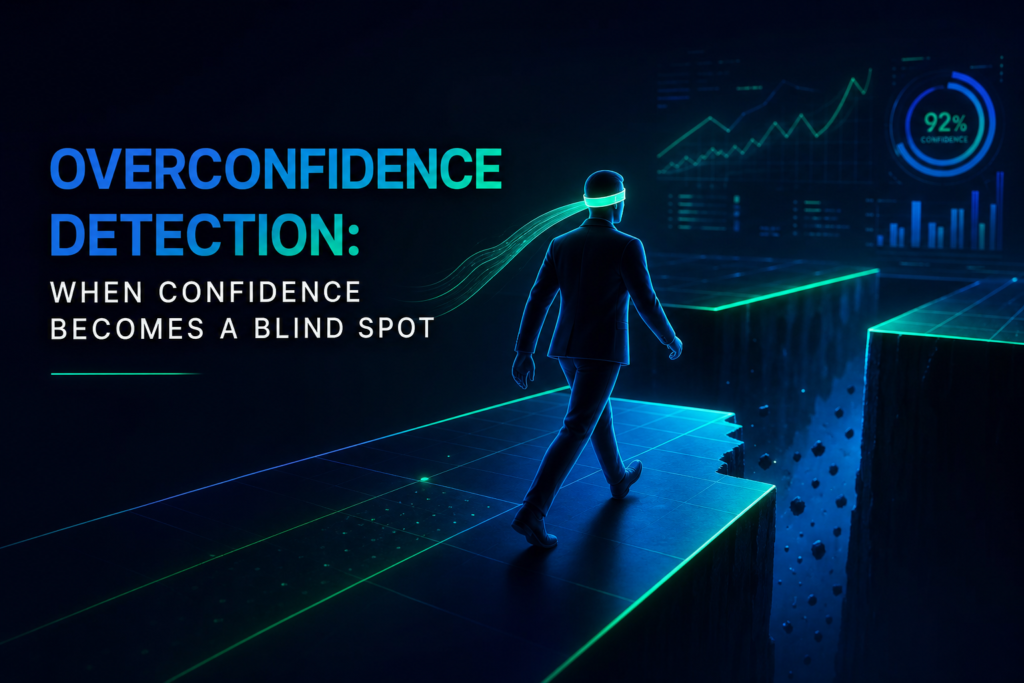


Confidence is the most valuable asset in your arsenal. It gets you out of bed, into the room, and past the gatekeepers. It fuels the first hire, the first sale, the first leap when the numbers don’t quite add up yet. Every founder, every high-performer, every person who builds anything of consequence runs on a surplus of confidence.
Which is precisely why it’s the most dangerous liability you have.
Not because confidence is bad. But because the feeling of being right and the fact of being right are two entirely different neurological events, and your brain is spectacularly bad at telling them apart.
The Overconfidence Trap Isn’t About Ego. It’s About Data.
Let’s kill the lazy interpretation first. Overconfidence isn’t a character flaw. It isn’t narcissism. It isn’t the hallmark of arrogance or the province of people who "think too highly of themselves."
Overconfidence is a systems problem. Your brain runs a predictive model of reality. That model is built from experience, pattern recognition, and a lifetime of feedback loops. The problem is that the feedback loops are often incomplete, biased, or delayed, and your brain never tells you which ones.
You make a call. It works. Your brain logs it as skill. You make the same call in a different context, slightly different variables, and it fails. Your brain scrambles to find an external cause because the internal model said this should work. That’s not ego. That’s a broken update cycle.
This is the core insight most leadership advice misses: overconfidence isn’t the opposite of self-doubt. It’s the same root problem viewed from a different angle.
Both are failures of accurate self-modeling. The person riddled with self-doubt has a model that underweights their competence. The person running on overconfidence has a model that overweights it. Neither one has an accurate read on where they actually stand relative to reality. And neither one can fix the problem from the inside, because the tool doing the assessment is the same tool that’s biased.
It’s like asking a corrupted hard drive to diagnose itself.
The Confidence-Competence Gap
Research from Dunning and Kruger put this on the map, but the implications go deeper than the meme. The least competent people in a domain consistently rate themselves as more competent than they are. But here’s the part people forget: the effect doesn’t disappear at the top. It just gets more sophisticated.
Experienced founders don’t overestimate their ability to code or write copy. They overestimate their ability to read markets, predict timing, assess people, and gauge when a strategy has shifted from "needs patience" to "needs killing."
These are exactly the domains where feedback is slow, noisy, and easy to reinterpret.
You raised at a valuation that made sense twelve months ago. Now the market has shifted, but you haven’t repriced your conviction because you’re still waiting for the data to confirm what you already believe. That’s not patience. That’s overconfidence wearing a founder’s uniform.
You promoted the person who was great at the startup phase but is now misaligned with the scale phase. You haven’t addressed it because your first judgment about them was strong, and questioning it feels like questioning your own ability to read people. It’s not. It’s updating a model with new data.
The gap between confidence and competence isn’t a single moment. It’s a slow drift that compounds in silence.
Why Your Brain Won’t Catch This Itself
The human mind has a built-in confirmation bias that functions as an immune system for your self-concept. Contradictory evidence gets filtered, rationalized, or quietly ignored. This isn’t a flaw you can fix with more discipline or better journaling prompts.
You can’t white-knuckle your way into objective self-awareness.
Here’s what actually works: external state tracking that runs independently of your emotional narrative.
Think about what a high-performance athlete does. They don’t just train and hope. They have coaches, video analysis, biometric tracking, and performance data that tells them what they’re actually doing versus what they think they’re doing. The gap between perception and reality is where every meaningful improvement lives.
You need the same thing for your operating system as a human being.
How AchieveAI Catches Blind Spots Before They Become Failures
This is exactly the problem AchieveAI was built to solve.
As a Personal Super Intelligence and Life Operating System, AchieveAI doesn’t just organize your tasks. It builds an objective model of your behavioral patterns, decision tendencies, and energy allocation over time. It creates what we call Cognitive Continuity, a persistent, accurate read on how you actually operate versus how you think you operate.
Here’s how that translates into overconfidence detection:
1. Objective State Tracking
AchieveAI monitors your commitments, follow-through rates, and decision outcomes without the emotional filter you bring to your own assessment. When your stated priorities and your actual time allocation diverge, it flags the gap. Not with judgment. With data.
2. Reflection Loops
The system surfaces patterns at regular intervals: What did you commit to last week? What actually happened? Where did you spend time versus where you said you would? These aren’t journaling prompts you’ll abandon after two weeks. They’re automated, frictionless, and grounded in your actual behavior.
3. Pattern Detection
Overconfidence shows up in patterns, not isolated incidents. Repeatedly overcommitting capacity. Consistently underestimating timelines for the same type of project. Failing to update a strategy when the inputs have clearly changed. AchieveAI’s pattern recognition catches these drifts before they compound into real failures.
4. Decoupled Prompting
Because AchieveAI operates across every tool and context you touch, it has a cross-domain view that your conscious attention never will. It can see that you’re hyper-optimizing your content pipeline while your revenue pipeline has gone dark. That’s a blind spot your focus, by definition, cannot catch.
The Leverage Move
Most high-performers won’t address overconfidence because they associate questioning their judgment with weakness. The actual leverage move is the opposite: treating your confidence as a powerful but imperfect instrument that needs calibration.
You don’t abandon confidence. You build a system that tells you when it’s pointed in the wrong direction.
That’s what AchieveAI does. It doesn’t replace your judgment. It sharpens it by showing you the gap between your perception and reality, consistently, objectively, and without the ego protection your brain insists on running.
The to-do list that completes itself starts with a you that accurately sees itself.
Ready to see what your blind spots actually look like?
AchieveAI is the Personal Super Intelligence that thinks with you and acts for you, tracking your patterns, surfacing misalignment, and catching drift before it costs you. Plans start at $49.99/mo.
Start your free trial at achieveai.io and build the self-awareness layer your ambition is missing.