


Goldman Sachs just issued a research note that will echo through every boardroom and Slack channel for the next quarter. Economist Elsie Peng argues that AI’s macroeconomic productivity gains won’t arrive until the early-to-mid 2030s.
Her evidence is historical. The PC revolution took roughly 20 years from breakthrough to measurable productivity acceleration. Generative AI, she says, is on the same timeline. The data supports the thesis: only 2% of S&P 500 companies mentioned AI productivity in their Q1 2026 earnings calls. AI is contributing to approximately 16,000 net job losses per month in the US, substitution outpacing augmentation. The conclusion is tidy and terrifying: we’re in the trough of a J-curve, and the payoff is a decade away.
Here’s the catch. They’re right about the Fortune 500 and completely wrong about you.
The Goldman analysis describes a specific problem: organizational inertia. When you’re managing a $50 billion enterprise with 40,000 employees, integrating AI into core operations means retraining a workforce, redesigning workflows, navigating procurement cycles, and convincing a board that the initial productivity dip is worth the long-term payoff. That’s the J-curve. It’s real. It takes years. Maybe decades.
But the J-curve exists because of the organizational capital that has to be reconfigured. The bigger the machine, the longer it takes to change direction.
Now consider the operator with no machine to reconfigure.
A solopreneur, a founder, a small team of three or five people. There is no procurement committee. There are no legacy workflows embedded in the cultural DNA of a 30-year-old institution. There is no workforce to retrain. The bottleneck Peng identifies, the human friction in the adoption curve, dissolves when the human is already the decision-maker. You don’t need organizational permission to integrate AI into your core operations. You need 15 minutes.
The J-curve is flat when you’re the one making the decisions.
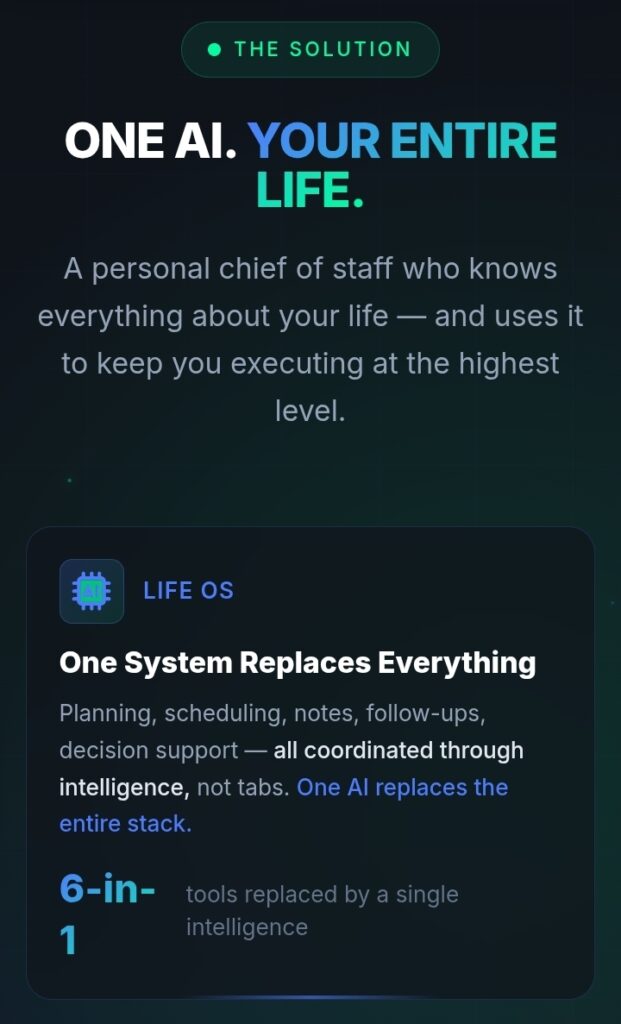
This is exactly the gap AchieveAI was built to exploit. A Personal Superintelligence that operates at the speed of an individual decision-maker, not a committee. No org chart to navigate. No workflow redesign initiative. No executive alignment sessions. Just context, execution, and results. Your calendar, your relationships, your outreach, your content, your research, unified into a single cognitive layer that learns you and acts for you.
The market is about to bifurcate in a way that creates the arbitrage opportunity of a generation. Large enterprises will spend the next 8 to 10 years chasing the productivity payoff that Goldman says is coming in 2034. They’ll burn billions on consultants, platforms, and change management programs. Meanwhile, the operators who skip the queue entirely will capture compounding advantage in real time. Every week that an enterprise is stuck in deliberation is a week an agile founder is 10x-ing their output with a fraction of the overhead.
That 15-year gap between when the enterprise gets its act together and when you do? That’s not just an advantage. That’s an entire career cycle of leverage.
Goldman Sachs is publishing research notes. You could be building the future they’re modeling.
The question isn’t when AI will boost productivity. It’s whether you’re going to wait for your organization’s permission, or take it yourself. AchieveAI is built for the second group. Start your free trial at achieveai.io.