

Guillermo Rauch, the CEO of Vercel, just made a public bet that validates everything we’ve been engineering toward. It’s not a feature. It’s not a partnership announcement. It’s an architectural declaration that will separate the next generation of serious AI systems from the ones that will fail in production.
The news, dropped on July 6, is straightforward. Vercel, handling 6 million deployments a day (half from coding agents) and one trillion tokens through its AI gateway daily, sees the future. Rauch argues that for agents to be production-grade, you must decouple the model layer from the agent logic. You optimize for price and performance, not vendor lock-in. He states 2025 was the prototyping year. 2026 is the year of production realities. The structural question, as he puts it, is "We’re deciding on whether the model and the agent are going to be coupled."
He argues the two killer apps are coding agents and internal corporate agents that help run the company. He’s right. And he’s only seeing the tip of the iceberg.
Why does this matter? Because the coupled model-agent approach is a architectural dead end. When your agent’s reasoning, memory, and execution are fused to a single model provider’s API, you’ve built a castle on sand. You have data lock-in. Every memory, every context window, every piece of learned preference is trapped in a proprietary silo. You have model dependency. When a better, cheaper, or more specialized model emerges, you face a brutal migration, not a simple swap. Your agent’s entire "personality" and learned state is at risk. And you have fragile reasoning. The system’s intelligence is hostage to the quirks and limitations of one provider’s architecture. If they deprecate an endpoint, change a pricing model, or suffer an outage, your autonomous operations cease.
This is the trap most "AI agents" are built into. They are sophisticated wrappers around a single model’s API call. They are not systems. They are features. They break.
True cognitive continuity requires a radical decoupling. Your personal memory, your relationship context, your autonomous execution protocols, your learned preferences across domains like health, work, and reputation, these cannot live inside a model provider. They must be sovereign. They must be yours.
Your agent shouldn’t stop working because you switched from GPT-4o to Claude 4 or Gemini Ultra. Your autonomous execution layer, the part that actually schedules your meetings, sends your outreach, and completes your tasks, should be persistent infrastructure, not a transient API call that resets context on every invocation.
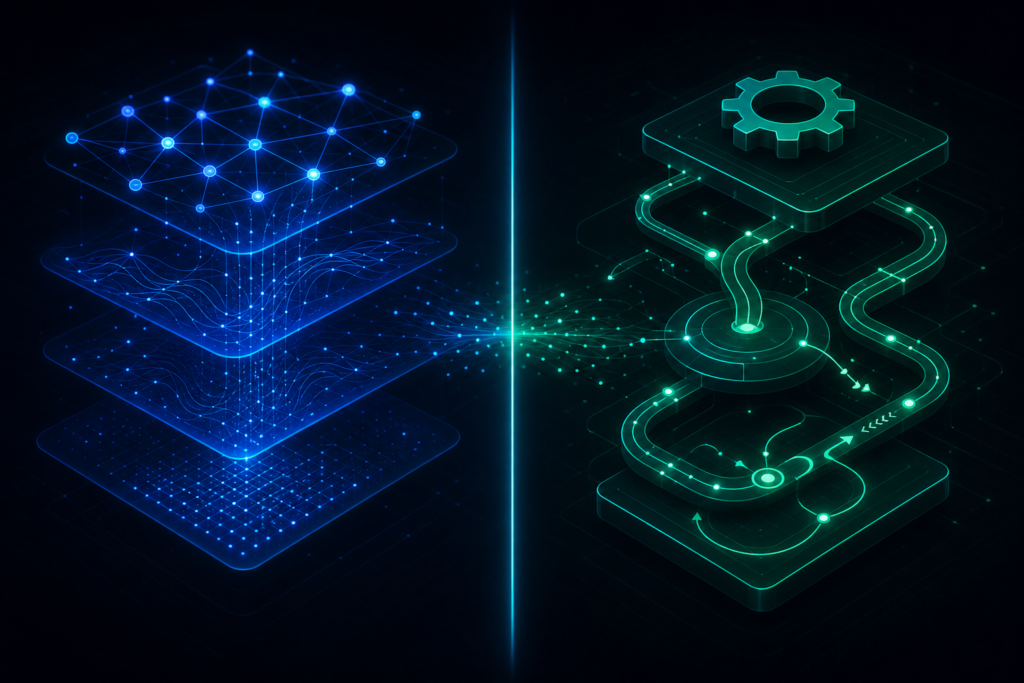
This is exactly the architecture AchieveAI is built on. We treat intelligence (the LLM reasoning) and agency (the autonomous execution) as separate, swappable layers. Your Infinite Memory and Cognitive Continuity are preserved in a sovereign layer. The reasoning model can be swapped underneath to optimize for speed, cost, or specific task performance without ever touching your data or your agent’s operational state. When a new frontier model drops, you don’t migrate your life. You upgrade your engine.
The "agent-model split" Rauch is arguing for isn’t just an infrastructure play for deploying websites. It’s the foundational principle for any system that claims to be a Personal Super Intelligence. It’s the difference between a tool that chats and a system that operates.
The market is waking up to what we’ve been building. The infrastructure Vercel is laying for the broader ecosystem, we’ve already internalized for the individual operator. The to-do list that completes itself isn’t a feature we added. It’s an architectural stance we took from day one.
We build for the operators who cannot afford system fragility. For the founders, solopreneurs, and high-net-worth professionals whose daily reality depends on relentless execution. You don’t need another app. You need a decoupled cognitive layer that acts with sovereignty.
The split is here. The question is whether your system is built for it.