

You have a fitness app, a budgeting spreadsheet, a notes app full of goals, a calendar packed with meetings, and a journal you forgot to open this week.
None of them talk to each other. None of them know what the others are doing. And none of them are built to answer the only question that actually matters: Is my entire life moving in the right direction, or am I just staying busy?
You’re not disorganized. You’re running three or four operating systems at once, each one managing a slice of your existence in isolation. Your body runs on one logic. Your business runs on another. Your mind, your relationships, your growth, they each get their own silo. And the result is a life that feels productive but strangely fragmented, like you’re winning in pieces while losing the whole.
That’s the problem. And it’s not a willpower problem. It’s an architecture problem.
The Myth of the Balanced Life
The productivity industry spent two decades selling you balance as the goal. Wake up early. Meditate. Cold plunge. Crush your revenue targets. Read 52 books a year. Sleep eight hours. Journal gratitude.
It sounds reasonable until you realize what it actually demands: that you maintain five separate systems, five separate tracking mechanisms, five separate feedback loops, and somehow synthesize all of them into coherent daily decisions using a brain that’s already running on fumes.
Balance isn’t the answer. Integration is.
A balanced life means your health, wealth, and mind are separate accounts you keep topped off. An integrated life means they are the same account, drawing from the same source, moving toward the same outcome, reinforcing each other automatically.
One is a to-do list. The other is an operating system.
What a Life OS Actually Does
Think about how your computer works. You don’t run separate machines for your email, your files, your browser, and your applications. You run one operating system that manages all of them, allocates resources between them, and creates a unified interface so you can interact with everything from a single place.
A Life OS does the same thing for your actual life.
It’s not another app. It’s the layer beneath the apps, the connective tissue that takes your health data, your financial targets, your relational commitments, your professional obligations, and your cognitive priorities, and runs them as one coherent system.
When your workout data informs your energy management, which informs your meeting scheduling, which protects your deep work blocks, which protects your revenue-generating output, which funds the lifestyle that supports your recovery, that’s integration. That’s a Life OS.
When those things exist in separate apps that never touch each other, that’s fragmentation wearing the costume of productivity.
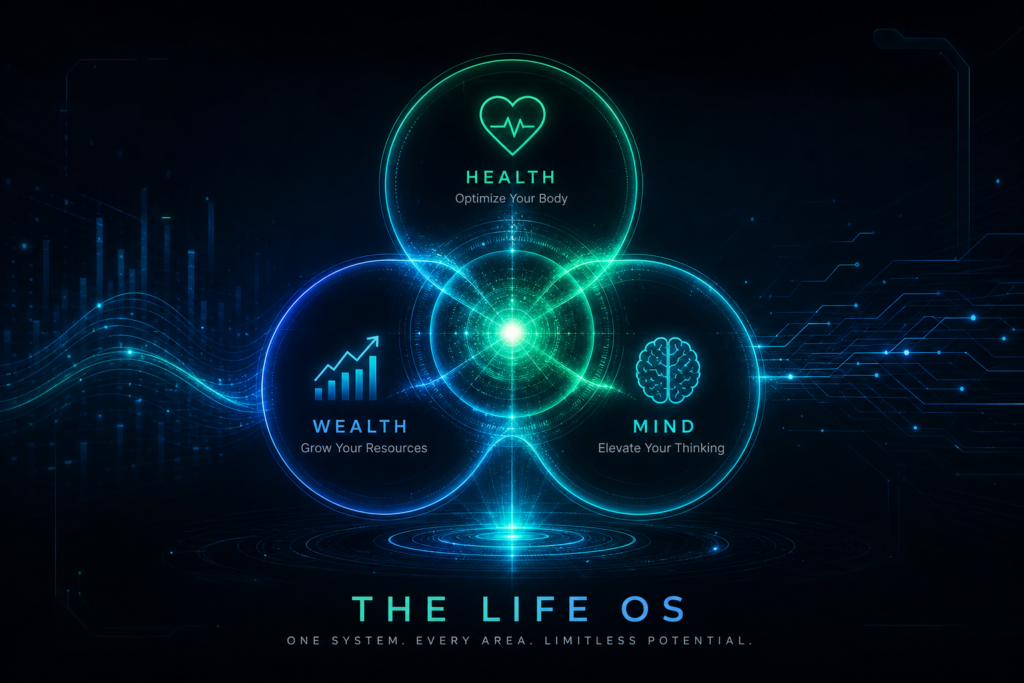
The Three Pillars Are Actually One Pillar
Here’s what most personal development gets wrong: it treats health, wealth, and mindset as three goals to pursue simultaneously.
They’re not three goals. They’re three expressions of one system.
Your body is your execution engine. Sleep, nutrition, movement, and recovery determine your cognitive bandwidth, your emotional regulation, and your decision-making quality. A founder who sleeps five hours and skips meals isn’t just unhealthy; they’re making worse strategic decisions, closing fewer deals, and reacting instead of leading.
Your wealth is your resource layer. Revenue, expenses, investments, and financial flow determine what you can afford to delegate, automate, and eliminate. A solopreneur manually handling every task isn’t just busy; they’re burning the cognitive capital they need for the work that actually grows their income.
Your mind is your operating logic. Focus, clarity, emotional state, and self-awareness determine how effectively you convert potential into output. A brilliant strategist who can’t manage their mental state isn’t just stressed; they’re underperforming their own capabilities by 40% or more.
These three layers don’t just coexist. They compound. When your body is optimized, your mind works better. When your mind works better, your business decisions improve. When your business decisions improve, your financial resources expand. When your financial resources expand, you can invest further in your health and environment.
That’s a flywheel. But it only spins when the pieces are connected.
Why Fragmentation Is the Real Cost
The cost of running a fragmented life isn’t just inefficiency. It’s invisible bleed.
Every context switch between apps costs cognitive load. Every manually tracked habit that falls through the cracks erodes trust in your own systems. Every missed follow-up, forgotten commitment, or misaligned action compounds into a persistent feeling that you’re working hard but not quite getting there.
Here’s what fragmentation looks like in practice:
- You set a revenue goal in January but never connect it to a daily execution plan that accounts for your energy cycles.
- You schedule a workout but cancel it because your calendar didn’t account for the late-night call that wrecked your recovery.
- You make a decision that’s financially smart but misaligned with your stated values, and you feel the disconnect but can’t pinpoint where it’s coming from.
- You crush a week of output and then crash because no system was monitoring the signs of burnout before they became a crisis.
Each of these is a systems failure. Not a personal failure. And systems failures require systems solutions.
The Cognitive Layer Most People Are Missing
A spreadsheet can track your finances. A fitness app can log your workouts. A journal can capture your thoughts. But none of them understand the relationships between these domains.
What’s missing is a cognitive layer, a system that doesn’t just store data but understands context. That knows your revenue target and adjusts your daily priorities to match. That notices when your sleep has been declining and flags the likely impact on your decision-making this week. That remembers your commitments to specific people and ensures follow-through without manual reminders.
This is what AI-powered life orchestration actually looks like. Not another chatbot that answers questions, but a persistent intelligence that maintains context across every domain of your life and acts on your behalf within the parameters you’ve set.
Think about the difference:
Without a Life OS: You manage everything manually. You track habits in one app, finances in another, tasks in a third. You rely on memory and discipline to connect them. When life gets chaotic, things fall through the cracks. You spend Sunday nights feeling behind.
With a Life OS: One system holds your entire context. It monitors your health metrics, tracks your financial trajectory, manages your relational follow-ups, protects your focus time, and executes tasks autonomously. You make fewer decisions about logistics and more decisions about direction. You spend Sunday nights reviewing progress, not catching up.
The first is a life of management. The second is a life of leverage.
What This Looks Like Inside AchieveAI
AchieveAI was built on this exact premise: that your life should run as one system, not forty-seven fragmented tools.
It’s a Personal Super Intelligence that maintains what we call Infinite Memory and Cognitive Continuity across every domain. It doesn’t just store what you told it last Tuesday; it understands how that commitment connects to your quarterly goals, your health targets, and your relational priorities.
Here’s what that means in practice:
- Your health, wealth, and mindset goals live in one system that tracks progress across all three and surfaces misalignments before they become problems.
- Autonomous execution handles the follow-through you’d otherwise do manually: outreach, scheduling, social posting, CRM updates, and task completion.
- Cognitive Continuity means the system remembers context across tools, conversations, and timeframes. You don’t re-explain yourself every session.
- Smart scheduling protects your time based on your actual energy patterns, not just available slots.
- Unified inbox management keeps your communications organized so nothing falls through the cracks, whether it’s a client DM or a personal follow-up.
The result isn’t just productivity. It’s coherence. The feeling that your life is actually moving as one unit toward outcomes you’ve chosen, rather than spinning in circles across disconnected domains.
The Operator’s Edge
High performers don’t need another habit tracker. They need an infrastructure advantage.
The gap between where you are and where you could be isn’t usually a knowledge gap. You already know what to do. It’s an execution gap, a systems gap, a coherence gap. The Life OS closes that gap by removing the friction between intention and action.
When your health data informs your business scheduling, when your financial targets drive your daily priorities, when your relational commitments execute automatically, when your mental state is monitored and protected by the system itself, you stop managing your life and start running it.
That’s not balance. That’s leverage.
Your Next Step
If you’ve been running your life across fragmented tools, disconnected apps, and manual systems that collapse the moment things get intense, you already know the cost.
The Life OS isn’t another tool to add to the pile. It’s the replacement for the pile.
AchieveAI is running a free trial right now. No credit card required. No onboarding calls. Just connect your life to a system that actually understands how the pieces fit together and starts executing on your behalf.
Your health. Your wealth. Your mind. One system. One interface. One direction.
Start your free trial at achieveai.io and feel what coherence actually sounds like.
If this resonated, share it with someone who’s still running five apps and wondering why they feel behind. Drop a comment below with the one area of your life where fragmentation costs you the most. And if you’re ready to stop managing and start operating, the link is right there.
The to-do list that completes itself isn’t a metaphor. It’s an architecture decision.