


You’re adding AI agents. Your operations are getting worse.
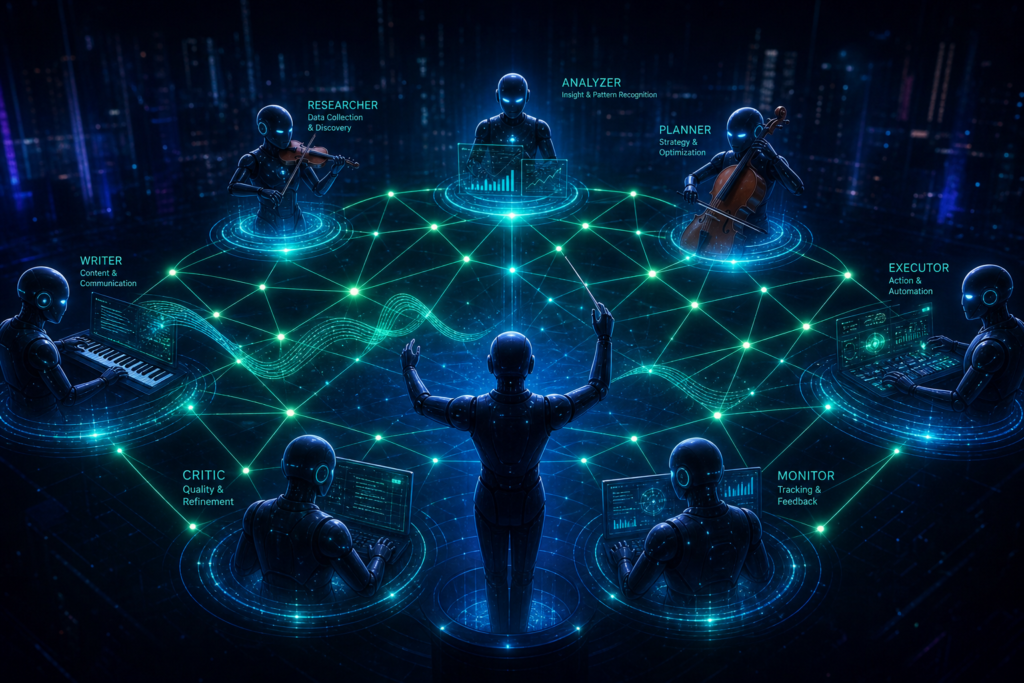
That’s not a bug. It’s the predictable outcome of deploying intelligence without infrastructure. A new piece from Deepa Chauhan at SiliconANGLE nails it: the enterprise agentic AI challenge isn’t getting agents to be smarter. It’s getting them to act like a team, not a crowd.
I read that and laughed. Not because it’s funny, but because we built AchieveAI around this exact insight two years ago while everyone else was still chasing the single-agent fantasy.
Here’s what’s actually happening, why it matters for your business, and what the fix looks like.
More Agents, More Problems
The logic seems airtight on the surface. One AI agent handles your email. Another manages your calendar. A third does social posting. A fourth runs your CRM. A fifth handles customer support. You’re saving so much time!
Except you’re not. You’re managing five separate systems that don’t talk to each other. Each one needs its own setup, its own prompts, its own maintenance. You’ve traded one set of manual tasks for five sets of fragmented AI tasks, plus the overhead of stitching them together.
Gartner reports that 38% of AI projects fail due to poor data quality. But here’s the real kicker: poor data quality is often a symptom of poor integration. When your calendar agent doesn’t know what your email agent just promised a client, you get a double-booking. When your CRM agent doesn’t know your social agent just posted about a product launch, you get a follow-up sequence that’s embarrassingly out of date.
For solo founders and SMB owners, this is personal. You don’t have a team of systems engineers to make your tools play nice. You’re the systems engineer. And every hour you spend configuring integrations between disconnected agents is an hour you’re not spending on the work that actually moves the needle.
The problem isn’t that your agents aren’t smart enough. It’s that they’re operating in silos. They’re a crowd of talented individuals who’ve never met, never shared notes, and have no idea what the others are doing.
That’s not a team. That’s chaos with a subscription fee.
The Four Pillars of Agentic Teamwork
Think about what makes an actual team function. Not a group of people in the same office, but a team that executes with precision and speed.
A restaurant kitchen is the perfect analogy. The line cook doesn’t just cook. The expediter calls orders. The sous chef coordinates timing. The head chef sets standards and resolves conflicts. Everyone has context on what everyone else is doing, in real time. The result: a hundred plates go out correctly, hot, and on time.
Now imagine that same kitchen where each cook only knows their own order ticket. No expediter. No shared ticket rail. No communication. You’d have chaos. Great individual cooks producing a terrible experience.
That’s most multi-agent setups today.
Based on what we’ve learned building coordinated AI systems, there are four pillars that separate a crowd from a team:
Pillar 1: An Orchestration Layer
This is the team captain. The expediter. The system that receives the original intent, breaks it into tasks, assigns those tasks to the right agents, and tracks completion. Without orchestration, agents duplicate work, contradict each other, and leave gaps. With orchestration, you get one coherent response to every trigger, whether it’s a new lead, a support ticket, or a scheduling request.
Pillar 2: Shared Memory
This is the team’s shared knowledge base. When your scheduling agent books a meeting, your CRM agent needs to know about it. When your outreach agent sends a follow-up, your social agent should be aware of the touchpoint. Shared memory means every agent operates from the same context. No more "I didn’t know about that" failures. No more conflicting outputs. The system remembers what matters, across every tool, every interaction, every time.
Pillar 3: Event-Based Communication
This is the real-time coordination. When one agent finishes a task or encounters an event, it doesn’t just log it somewhere. It triggers the next relevant action. A support ticket closes, and the follow-up sequence begins. A deal closes, and the onboarding agent activates. A social post goes live, and the analytics agent starts tracking. This is what transforms a collection of tools into a workflow that actually flows.
Pillar 4: Governance
This is the quality control. The standards. The rules that prevent agents from going off-script, spending too much, or making decisions outside their authority. Governance ensures that as you add capabilities, you don’t add risk. It’s the reason your restaurant doesn’t serve a dish the head chef never approved.
These four pillars aren’t theoretical. They’re the architectural foundation of every high-performing AI system I’ve seen. And they’re the reason AchieveAI doesn’t just give you agents. It gives you a coordinated intelligence that thinks, remembers, communicates, and acts as one.
What This Means for Your Business
Let’s make this concrete.
Customer Support: Imagine a new inquiry comes in through your website. Your AI agent responds immediately with a personalized message, pulling from shared memory to reference the prospect’s previous interactions, social engagement, and where they are in your pipeline. If the agent can’t resolve the issue, it doesn’t just escalate. It logs the context, updates the CRM, and triggers a follow-up sequence. All orchestrated. All coordinated. All happening without you touching a single tool.
Sales Follow-Ups: A prospect downloads your guide. Your system sends the guide. Two days later, a different agent sends a relevant case study. Four days later, a third agent checks if they’ve engaged with either email and adjusts the cadence. Each agent knows what the others did because they share memory and operate under a unified orchestration layer. The prospect experiences one coherent relationship, not a series of disconnected touches.
Daily Operations: You wake up. Your system has already triaged your email, prioritized your tasks based on your actual priorities (not just recency), blocked focus time, drafted responses for your approval, and flagged the one conversation that needs your personal attention. This isn’t five separate tools giving you five separate summaries. It’s one intelligence, one view, one action plan.
Without coordination infrastructure, you’re not building a team. You’re paying for noise.
The enterprises Deepa Chauhan wrote about are discovering this at scale. But here’s the thing: you don’t need to be a Fortune 500 company to need this. If you’re a solo founder running three or four AI tools, you’re already dealing with the fragmentation problem. The difference is you can’t afford a systems integration team to fix it.
That’s exactly why we built what we built.
The Real Unlock Is Orchestration
The AI industry has an obsession with capability. Bigger models. Smarter agents. More features. But capability without coordination is just expensive potential.
The real unlock, the thing that separates companies getting genuine ROI from AI versus companies burning cash on agents that create more work than they save, is orchestration. It’s the difference between a crowd and a team. Between a collection of tools and a system that actually operates.
At AchieveAI, we built our platform around this exact insight. AI agents are powerful. But they’re transformative when they work as a coordinated team with shared memory, real-time communication, intelligent orchestration, and governance.
That’s not a feature. That’s the architecture.
Stop adding agents. Start building a team.
Ready to see what a coordinated AI system actually looks like? Start your free trial today at achieveai.io.
,
Article references "Agentic AI’s challenge is getting agents to act like a team, not a crowd" by Deepa Chauhan on SiliconANGLE, June 20, 2026.