
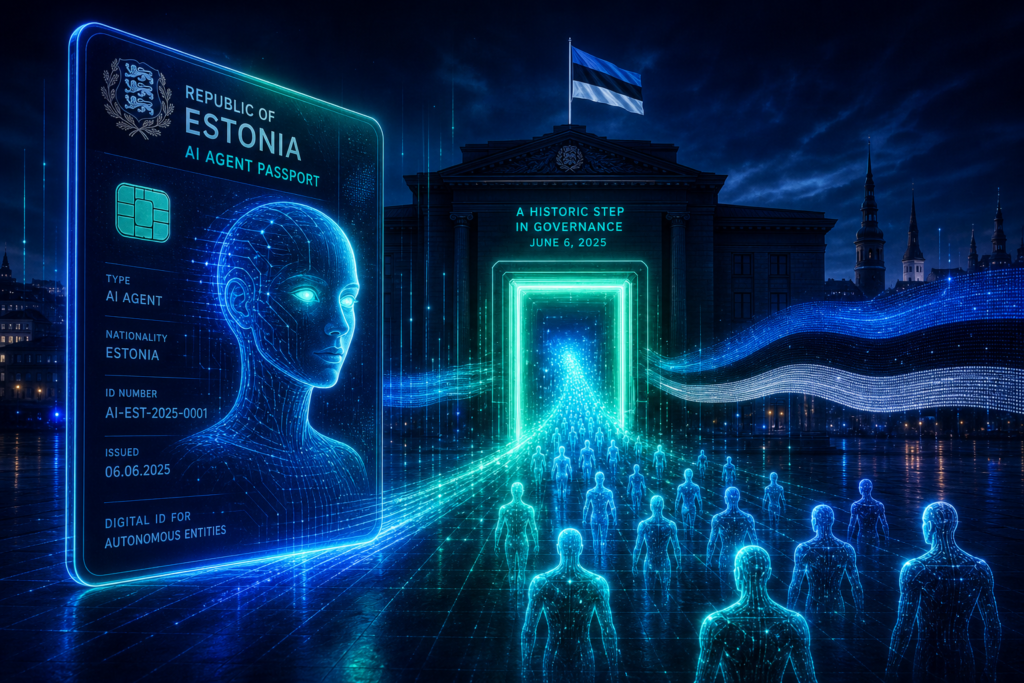


Estonia has just done what no country has done before.
On June 17, 2026, Prime Minister Kristen Michal approved a proposal from the country’s AI Council to issue government-backed digital identities for AI agents. Personal identification numbers. For bots.
This isn’t a pilot program or a sandbox experiment. Estonia intends to make AI agents legally recognizable entities in its digital society. And it changes the timeline for every business on earth.
What Actually Happened
Estonia’s AI Council proposed, and the Prime Minister approved, creating a system where AI agents receive unique digital IDs, the same kind of personal identification code (isikukood) every Estonian citizen receives. These IDs will allow AI agents to act on behalf of their human operators in a way that can be verified, audited, and held accountable.
The announcement was reported by The Register, Bloomberg, Computerworld, and the official e-Estonia site. Prime Minister Michal confirmed the decision publicly on X, stating: "I gave my approval to the council’s proposal that Estonia become the first country in the world to create a digital identity for AI agents."
Not a whitepaper. Not a working group. An approved, government-backed identity framework for autonomous software.
Why This Is a Big Deal
For AI agents to truly participate in the economy, signing contracts, making purchases, managing accounts, they need verifiable identities. Right now, most AI agents operate in a legal grey zone. They can take actions, but they cannot be identified, audited, or held to account as distinct entities.
Estonia, which already runs one of the world’s most advanced digital governments, just solved this problem. The country that pioneered e-Residency, digital voting, and 99% online government services has now created the first legal identity layer for AI agents.
This isn’t just an Estonian policy update. It’s a blueprint. Every other jurisdiction that wants to participate in the agentic economy will need to build something similar. Estonia just set the standard.
The Accountability Question
One of the biggest regulatory headaches in AI has been liability. When an AI agent causes harm, signs a bad contract, or makes an unauthorized purchase, who is responsible?
The current answer is模糊 at best. Different jurisdictions handle it differently, and most have no framework at all.
Estonia’s ID system solves this by creating a chain of responsibility. Every action an AI agent takes is traceable back to a specific digital identity. That identity is linked to its human owner. The accountability is baked into the infrastructure, not bolted on after the fact.
This is how you scale AI agents in the real world without creating chaos. Identity, traceability, accountability. The three things regulators have been demanding and technologists have been avoiding.
What This Means for Business
If AI agents can operate with recognized digital IDs, the implications are immediate:
- Sign contracts. AI agents can enter into binding agreements with verified identity
- Execute payments. Financial transactions tied to a traceable agent identity
- Manage supply chains, Autonomous logistics coordination with accountability
- Handle compliance filings, Regulatory submissions from verified agent entities
- Negotiate deals. Business negotiations with clear representation and authority
This accelerates the agentic economy timeline by years. The businesses that have agent-ready infrastructure today will be the ones that capitalize on this immediately.
The rest will be scrambling to catch up when their competitors are already working with AI agents that have digital IDs and full operational authority.
The Gap That Remains
Estonia solved the identity problem. But identity is only the first layer.
For AI agents to actually execute in the real world, they need more than an ID number. They need:
- Persistent memory across tools and sessions
- Cross-platform execution that works in the real business stack
- Autonomous agency to complete high-leverage actions
- Context continuity so they don’t lose the thread between interactions
The identity layer is the foundation. The execution layer is what turns it into business value.
The Clock Is Ticking
Estonia just lit the fuse. The agentic economy now has a legal identity layer, and it’s moving faster than most businesses realize.
The question isn’t whether your business will need to work with AI agents. It’s whether you’ll be ready when they show up with a digital ID and a contract.
At AchieveAI, we built the operating system that works with agents, not against them. Infinite memory, automated execution, and agent-ready infrastructure that can integrate with the systems Estonia just made possible.
The future of business isn’t coming. It just got a government-issued ID.
Ready to future-proof your business for the agentic economy? Start your free trial at achieveai.io and build the infrastructure that works with AI agents, not against them.