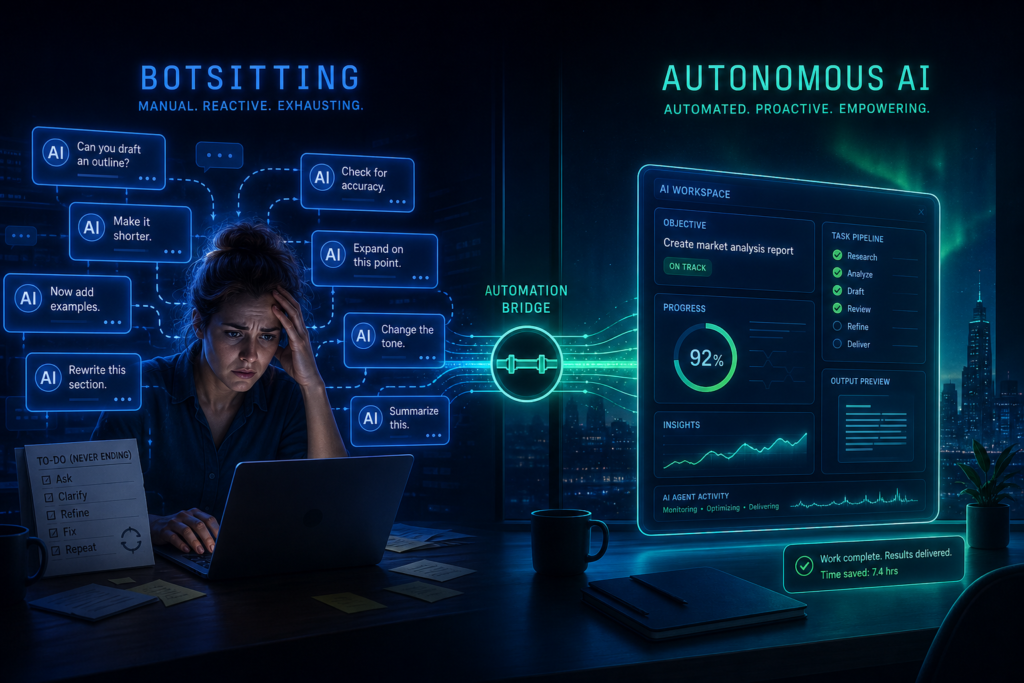


AI promised to free you. Instead, it gave you a new job: babysitter.
A new wave of research confirms what many operators already feel in their bones. The WION Fineprint report, citing Glean research, found that the average worker now spends 6.4 hours per week managing their AI tools. That’s not using AI. That’s supervising it. Feeding it context. Checking its outputs. Fixing its mistakes. Rephrasing the prompt because it hallucinated your entire Q3 plan.
BCG’s 2026 Global AI at Work report puts the full picture in perspective. Workers report saving roughly 11 hours per week thanks to AI. But 6.4 of those hours get immediately consumed by botsitting. The net gain? A mere 4.6 hours. You didn’t get 11 hours back. You got a part-time job with a chatbot.
Bloomberg covered the phenomenon as a growing productivity paradox: the more AI tools enter the workflow, the more human oversight they demand. The tools were supposed to collapse labor. Instead, they created a new category of invisible labor that nobody tracks on a timesheet.
Here’s the math that should bother you. If you’re paying a knowledge worker $150,000 a year and AI "saves" them 11 hours but costs 6.4 of those hours back in supervision, the true annual cost of botsitting is over $11,000 per employee. Multiply that across a team. Across a company. The numbers get ugly fast.
The Real Problem Isn’t AI. It’s AI That Needs You.
Most AI tools operate on a simple contract: you provide the context, they provide the output. Every new task requires a fresh prompt. Every new project requires re-explaining the background. Every handoff between tools requires manual context transfer.
This is the fundamental flaw of what we call assistive AI. It assists, but it cannot act independently. It waits for you. It needs your input at every stage. It generates a draft, then waits for your edit. It schedules a meeting, then asks you to confirm. It drafts an email, then requires your approval.
The productivity gains are real, but they come with a tax. And the tax is your attention.
Glean’s research highlights the specific activities eating those 6.4 hours: reformatting AI outputs to match company standards, correcting factual errors, providing additional context the AI missed, switching between AI tools that don’t share information, and manually triggering follow-up actions that should be automatic.
None of this is intelligence augmentation. It’s cognitive janitorial work.
Assistive vs. Autonomous: The Distinction That Matters
Not all AI is created equal. The market is splitting into two fundamentally different categories, and understanding the difference will determine whether AI actually saves you time or just redistributes it.
Assistive AI requires you at the helm. You prompt, it responds. You check, it waits. You correct, it regenerates. This category includes most chatbots, writing assistants, and point solutions that handle one slice of your workflow but require your brain to connect the pieces.
Autonomous AI handles entire workflows without human babysitting. It takes in your vision, your preferences, your constraints, and then executes across multiple systems. It follows up when needed. It escalates only when necessary. It learns your patterns and applies them consistently.
The difference isn’t sophistication. It’s architecture. Assistive AI treats you as the orchestrator. Autonomous AI makes itself the orchestrator and frees you to focus on decisions that actually require human judgment.
What Happens When AI Handles the Follow-Through
This is the shift we built AchieveAI to lead.
Most professionals don’t lack AI tools. They lack AI that completes the loop. They can generate an outreach sequence but can’t get the AI to actually send the emails, text the contacts, schedule the follow-ups, and track who responded. Each step requires manual intervention. Each handoff costs attention.
AchieveAI operates as a Life Operating System with Autonomous Agency. It takes your networking strategy, your follow-up protocols, your scheduling preferences, and your communication style, then executes entire sequences without supervision.
The emails go out. The texts follow up. The calendar invites send. The CRM updates. The follow-up sequence triggers based on response or silence. All of it runs while you focus on the meeting, the deal, the decision that actually needs you.
No prompt engineering required. No context re-feeding. No output checking on routine communications. The system learns your patterns through Infinite Memory and applies them consistently across every interaction.
For operators running high-volume networking, deal flow, or team coordination, this isn’t incremental improvement. It’s the elimination of an entire category of cognitive overhead.
The Math Changes When Botsitting Goes to Zero
Go back to that 6.4 hours per week. What happens when it disappears entirely?
For a founder running a $3M company with a lean team, reclaiming those hours across even three key operators returns nearly 20 hours per week of actual productive capacity. At a loaded cost of $100/hour for senior operators, that’s $104,000 per year in recaptured cognitive capital.
That’s not a productivity hack. That’s a structural advantage.
The WION report concluded that "the promise of AI-driven productivity remains largely theoretical for most workers." The reason is architectural, not technological. The models are capable enough. The tools are powerful enough. But the implementation requires too much human scaffolding.
Autonomous AI removes the scaffolding.
The Real Question
The botsitting crisis isn’t going to resolve itself. As companies deploy more AI tools, the supervision burden multiplies. Every new tool requires new context. Every new integration requires new maintenance. The 6.4 hours will grow unless the underlying approach changes.
The question isn’t whether AI saves time. It clearly does. The question is whether your AI saves time net of the time it costs to manage it.
If you’re spending hours each week babysitting your AI tools, the problem isn’t your discipline or your workflow. It’s your architecture.
AchieveAI eliminates the botsitting layer entirely. Autonomous follow-up sequences, self-orchestrating communications, and Infinite Memory across every interaction. The system that thinks with you and acts for you, without requiring you to stand over its shoulder.
Your 6.4 hours are waiting. Start your free trial at https://achieveai.io and take them back.
Sources:
– WION Fineprint Report: "AI Productivity Gap: Is ‘Botsitting’ Wasting More Time Than It Saves?" (2026)
– Glean Research: 6.4 hours/week average AI supervision time among knowledge workers
– BCG: 2026 Global AI at Work Report
– Bloomberg: Coverage of AI productivity paradox in enterprise adoption