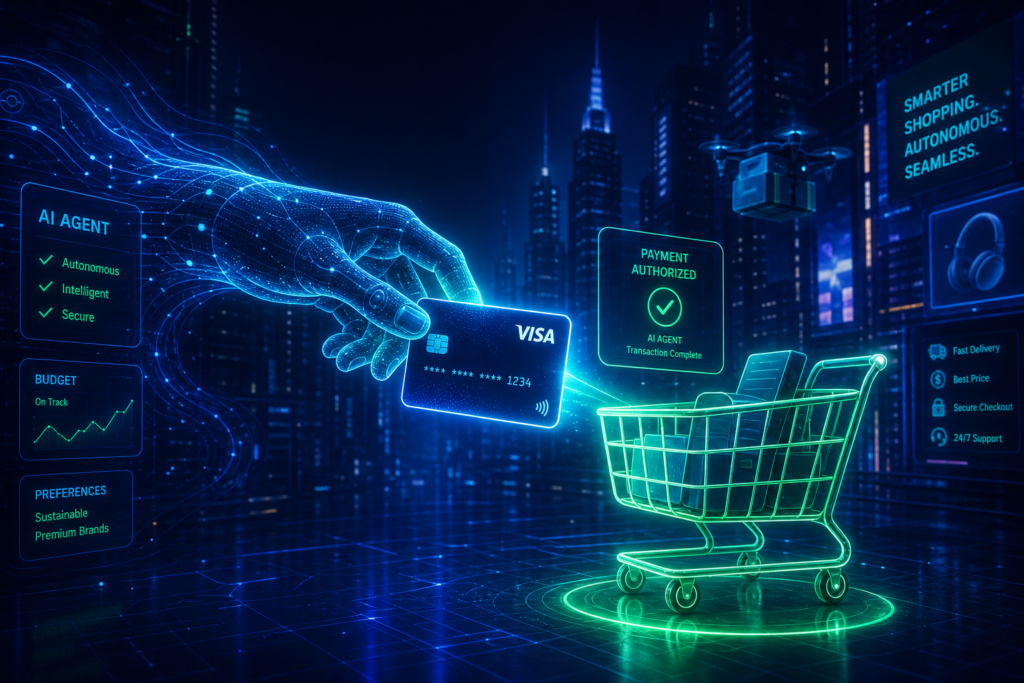


On June 10, 2026, Visa and OpenAI made a move that will look inevitable in hindsight. At the Visa Payments Forum, Visa announced a strategic collaboration to integrate its payment network directly into OpenAI’s experiences, enabling AI agents to make purchases on behalf of users (Visa Corporate, 2026).
This is not a chatbot that can click "buy now." This is Visa’s full payment infrastructure, tokenized credentials, real-time authorization, and fraud monitoring, deployed inside ChatGPT and other OpenAI interfaces. Users set their own guardrails: spending limits, approved merchant categories, and approval thresholds. The AI agent executes within those boundaries, autonomously.
SiliconANGLE called it a watershed moment for agentic commerce. Bloomberg characterized it as the most significant institutional bet on AI-driven transactions to date. Both are right.
Jack Forestell, Visa’s Chief Product Officer, put it plainly: "AI will transform commerce more profoundly than the internet or mobile technology ever did" (Visa Corporate, 2026).
He’s not exaggerating. And if you’re only thinking about this as "AI shopping," you’re missing the real story.
The Infrastructure Layer for AI Economic Actors
What Visa and OpenAI just built is not a feature. It is infrastructure.
The payment rails are the foundation. When AI agents can transact with the same security, compliance, and trust guarantees as a human entering a credit card number, the entire model of online commerce shifts. AI stops being a research tool that helps you decide what to buy and becomes an economic actor that executes the purchase itself.
Think about what that means. Your AI agent doesn’t just compare prices or draft a shopping list. It identifies the optimal product, negotiates or selects based on your preferences, authorizes payment, and handles follow-up, all within rules you defined. The user experience collapses from twenty minutes of browsing to a single approval prompt, or in many cases, no prompt at all.
Visa’s framework includes layered authentication and real-time risk scoring. The tokenized credentials mean your actual card number never touches the AI system. The guardrails mean you retain control. The fraud monitoring means Visa’s existing infrastructure protects every transaction, whether a human or an agent initiated it.
This is the plumbing that an agentic economy requires. And now it exists.
Why the Payments Layer Is Not the Bottleneck
Here’s the part most coverage is missing.
Payment infrastructure is necessary, but it is not sufficient. Visa and OpenAI solved the last mile: how an AI agent completes a transaction. But the real leverage in any sales-driven business happens upstream, before the payment, before the cart, before the checkout.
The bottleneck has never been processing a payment. The bottleneck is the entire workflow that gets a prospect to the point of purchase.
Lead generation. Qualification. Personalized outreach. Follow-up sequences that don’t drop leads through cracks. Relationship management across channels. Context continuity when a prospect moves from a LinkedIn DM to an email thread to a demo call.
This is where most businesses, even sophisticated ones, hemorrhage revenue. Not because their product is weak, but because their sales pipeline runs on manual processes, fragmented tools, and human attention that doesn’t scale.
The agentic economy amplifies this problem. When AI agents are evaluating options and making purchasing decisions on behalf of users, the businesses that win are the ones with the most intelligent, persistent, and context-aware sales pipelines. The AI agent comparing your solution to a competitor’s doesn’t care about your beautiful website. It cares about the structured data, the response speed, the follow-up cadence, and the relevance of every touchpoint.
What the Agentic Economy Actually Demands
Visa and OpenAI are building the transaction layer. Mastercard is pursuing similar integrations. Ripple just announced XRP-based payment support for AI agents on its XRPL network. The financial infrastructure is converging on a single reality: AI agents will transact.
But the businesses that thrive in this environment will be the ones that solve the pipeline problem.
Consider the current state of most sales operations. A lead enters through a website form, an ad, or a referral. A human reviews it, qualifies it, and decides when to follow up. Context lives in someone’s head or scattered across a CRM that nobody maintains. Follow-up happens in bursts, not systematically. The average response time to a new lead is still measured in hours, not minutes.
Now imagine an AI agent evaluating your business on behalf of a user. It sends an inquiry. It expects structured, relevant, timely engagement. It compares your response to three competitors simultaneously. The one with the fastest, most context-aware follow-up wins the transaction.
That is not a hypothetical scenario. That is the environment Visa and OpenAI just accelerated.
The Pipeline Is the Competitive Advantage
The companies that will dominate AI agent commerce are not just the ones with great products. They are the ones with intelligent pipeline management that can match the speed and sophistication of AI-driven buyers.
This requires a fundamentally different approach to sales and outreach:
Context continuity across every touchpoint. When a prospect interacts with your brand through multiple channels, the system must carry that context forward without loss. No more asking a lead to repeat themselves because the CRM didn’t capture the last conversation.
Autonomous follow-up that adapts. Not spam sequences, but intelligent outreach that responds to signals, adjusts timing based on engagement patterns, and escalates to human involvement only when the situation demands it.
Proactive pipeline management. The system should surface opportunities, flag stalled deals, and initiate next steps without waiting for a human to remember.
Cross-tool orchestration. The moment your sales process requires switching between five apps to complete one follow-up, you’ve lost. The pipeline needs to operate as a unified layer, not a collection of disconnected point solutions.
This is what AchieveAI was built for. Not as another CRM or task manager, but as the orchestration layer that connects your vision, your pipeline, and your execution into a single cognitive system with infinite memory and autonomous agency.
What Happens Next
The Visa-OpenAI collaboration is a starting gun. Within twelve months, AI agent commerce will move from novelty to expectation. Businesses that wait for the market to mature before adapting will find themselves competing for scraps against operators who built intelligent pipelines now.
The payment rails are here. The agents are coming. The question is whether your business can keep up.
Visa made the first move. The businesses that follow will be the ones that didn’t just watch the announcement, they built for the reality it created.
,
Want your business ready for the agentic economy? Your customers are already using AI to make decisions. Make sure your follow-up and sales pipeline runs on AI too. Start your free trial at AchieveAI.
,
Sources:
- Visa Corporate. "Visa and OpenAI Announce Strategic Collaboration to Enable AI-Powered Commerce." corporate.visa.com, June 10, 2026.
- SiliconANGLE. "Visa, OpenAI Push AI Agents Into Online Shopping." siliconangle.com, June 11, 2026.
- Bloomberg. "Visa Connects With ChatGPT to Let AI Agents Automatically Make Purchases." bloomberg.com, June 11, 2026.