
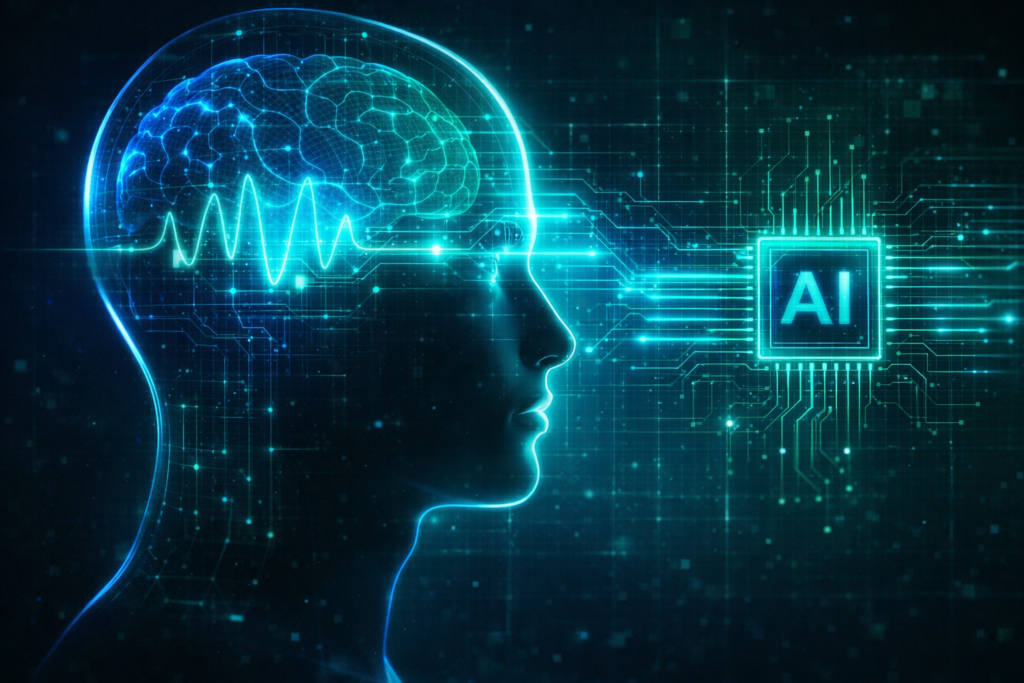


Real-Time Reframing: How AI Acts as a Translation Layer for Your Negative Self-Talk
You are your own most frequent interlocutor. Every day, an internal monologue runs a constant commentary on your actions, your potential, and your failures. For the ambitious high-performer, this monologue isn’t always a coach; often, it’s a critic. This “mental friction”—the gap between what you want to achieve and what your brain tells you is possible—is the single greatest bottleneck to elite performance.
In the world of high-stakes leadership and innovation, your psychology is your operating system. If that OS is riddled with the malware of negative self-talk, your output will always be compromised. But what if you could install a real-time translation layer to refactor that code as it’s being written?
The Neurological Tax of the Internal Critic
Negative self-talk isn’t just a “bad mood.” It’s a physiological event. When you think, “I’m not ready for this pitch,” or “This project is going to fail just like the last one,” your brain triggers the amygdala. This releases cortisol, narrows your cognitive field, and effectively shuts down the prefrontal cortex—the part of your brain responsible for strategy, creativity, and complex problem-solving.
You aren’t just feeling bad; you are literally making yourself less intelligent in real-time. For CEOs and founders, this cognitive tax can cost millions in missed opportunities and poor decision-making.
The Concept of the Digital Translation Layer
In computing, a translation layer allows two incompatible systems to communicate. In the context of human performance, AI is now stepping into this role for our own thoughts.
Real-time reframing is the process of taking a “low-signal” thought (negative, emotional, or limiting) and translating it into a “high-signal” action (objective, constructive, or strategic).
- Raw Thought: “I’m totally overwhelmed and I’ll never finish this.”
- Reframed Signal: “I have a high volume of complex tasks. I need to prioritize the top 20% that drive 80% of the value.”
The difference between those two sentences is the difference between a paralyzed afternoon and a breakthrough win.
How AchieveAI Refactors Your Reality
AchieveAI was built on the principle that intelligence should be proactive, not just reactive. We don’t just manage your tasks; we manage the cognitive environment in which those tasks exist.
By integrating AI directly into your workflow, AchieveAI acts as that essential translation layer. When you input goals or track progress, our system uses advanced linguistic analysis to detect patterns of friction. It doesn’t just record what you do; it helps you optimize how you think about what you do.
Through the AchieveAI interface, “impossible deadlines” are reframed into “structured milestones.” “Failures” are translated into “data-driven pivots.” We provide the external perspective necessary to break the loop of negative self-talk before it settles into a performance-killing habit.
The Future of Human-AI Symbiosis
The next frontier of human evolution isn’t physical—it’s cognitive. We are moving toward a world where the most successful individuals aren’t just the ones with the best skills, but the ones with the most optimized internal environments.
AI as a translation layer is the ultimate leverage. It allows you to bypass the evolutionary “glitches” of fear and doubt, keeping you in a state of high-agency flow for longer periods.
Stop letting your internal critic run your business. It’s time to upgrade your mental operating system and experience the clarity of real-time reframing.
Enjoyed this article? Share it with a fellow founder or leave a comment below with your favorite strategy for beating negative self-talk.