


Imagine this scenario: You submit a pitch deck to a tier-one venture capital firm. You send a cold outbound message to a prospective enterprise buyer who could double your ARR. You apply to join an exclusive, high-ticket master network of founders.
You wait. Days pass. Silence.
You assume they looked at your pitch, read your resume, or reviewed your case studies and decided it was not a fit.
You are wrong.
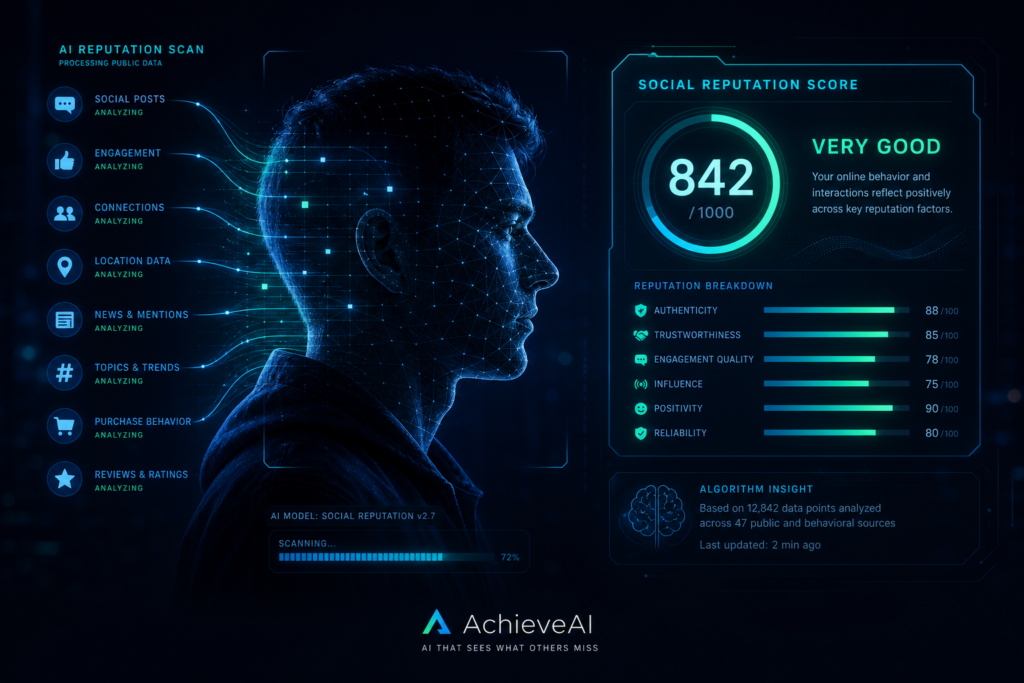
In all likelihood, a human never even looked at your deck. Instead, their system automatically ran your name through an API. Within three seconds, an LLM parsed your entire digital footprint, analyzed your public profiles, cross-referenced your activity, and assigned you a reputation score. Because your digital authority did not meet their algorithmic threshold, your message was routed straight to the archive.
This is not a dystopian projection of the future. It is happening today, in 2026.
As artificial intelligence becomes deeply integrated into executive recruiting, enterprise sales, venture capital, and elite networking, the traditional vetting process has been entirely automated. AI social analysis engines are working quietly in the background, grading your relevance based on public metadata. Before an investor, customer, or partner ever speaks to you, an algorithm has already decided whether you are a high-agency operator or a low-value distraction.
If you are treating your online presence as an optional diary or a casual resume, you are losing opportunities you will never even hear about. To survive and dominate this landscape, you need to understand exactly how AI social reputation scoring works and how to optimize the status signals the algorithm tracks.
The Invisible Audit: How AI Social Analysis Works
Traditional vetting used to be simple. A human looked at your website, checked your LinkedIn connections, and asked around for references. Today, that process is too slow, too subjective, and entirely unscalable.
Modern sales, finance, and partnership systems now rely on social proof AI. These systems leverage custom scrapers and large language models to construct a comprehensive profile of your digital footprint. They do not just read your bio. They analyze every post you write, every comment you leave, the semantic complexity of your arguments, and the status of the people who interact with you.
This is not about vanity metrics. The algorithm does not care if you have fifty thousand bought followers or a feed filled with generic, AI-generated platitudes. In fact, it penalizes you for them. Instead, it looks for deep patterns of authority, alignment, and leverage.
If your digital presence is scattered, superficial, or inactive, your reputation scoring drops. If your activity demonstrates high-agency action, cognitive consistency, and genuine professional leverage, you are fast-tracked directly to the decision-maker.
Here are the five critical status signals the algorithm evaluates to determine your place in the digital hierarchy.
1. Cognitive Consistency and Narrative Depth
Most people think personal brand optimization means posting daily. So, they hire a low-cost agency or use basic AI tools to churn out generic advice about productivity, growth hacking, or leadership.
This is a critical mistake.
When sophisticated AI engines run a LinkedIn authority check on your profile, they look for cognitive consistency. The system analyzes the semantic depth of your content over months, evaluating whether you possess deep, specialized knowledge or if you are simply repeating platitudes.
The algorithm can easily distinguish between high-value original insights and cheap, templated filler. It measures your vocabulary, the structure of your arguments, and the uniqueness of your positioning. If your profile reads like an index of generic industry buzzwords, the AI flags you as a low-authority node. True authority is marked by highly specific, original frameworks and real-world execution.
2. Network Density and Association Metrics
In the physical world, your reputation is defined by who you know. In the algorithmic world, your reputation is calculated by the density and authority of your digital network.
When evaluating your AI social reputation, the scoring system does not just look at your connection count. It analyzes the profile of every individual who interacts with your content.
If your posts are primarily liked and commented on by low-level offshore accounts, junior-level employees, or engagement pods, the algorithm immediately discounts your authority. Conversely, if your content attracts engagement from verified founders, managing partners, and industry executives, your digital authority score skyrockets.
The system maps the distance between you and known power players in your industry. If you want to perform at the highest levels, your AI-powered networking strategy must focus on attracting high-status interactions, not high-volume noise.
3. Engagement Authority and Discourse Quality
How do you interact with other people’s content? If your comments consist entirely of things like "Great point!" or "Totally agree, thanks for sharing," you are damaging your reputation score.
An AI social analysis engine evaluates the substance of your outbound interactions. It looks at the quality of the discourse you engage in. Are you adding value to the conversation? Are you offering counter-arguments, sharing data, or introducing new frameworks?
High-status operators do not leave empty pleasantries; they participate in high-level intellectual exchange. By writing valuable, long-form comments on the posts of other industry leaders, you signal to the algorithm that you are a peer to those leaders. This dramatically boosts your relevance in search results and automated talent sourcing pipelines.
4. Content Velocity and Information Freshness
Algorithms prioritize momentum. To maintain a high reputation score, you must demonstrate a consistent content velocity. This does not mean spamming the feed; it means showing up with a consistent, predictable rhythm of high-value insights.
A profile that has not posted or engaged in three months signals to the algorithm that the user is inactive, out of touch, or irrelevant. In the digital economy, silence is interpreted as stagnation.
Your content velocity acts as a real-time pulse check of your business. It shows that you are actively building, actively learning, and actively leading. When your content velocity remains high, the algorithm recognizes that you are an active node in the industry network, surfacing your profile to recruiters, investors, and potential clients who are looking for active partners.
5. Off-Platform Social Proof Signals
Your LinkedIn authority does not exist in a vacuum. Advanced reputation scoring systems conduct cross-platform audits to see if your narrative holds up across the web.
The AI looks for citations, mentions, podcast appearances, newsletter features, and open-source contributions. It cross-references your claims on your personal website with the data available in public registries, press releases, and corporate databases.
If you claim to be a high-growth founder but have zero external digital footprint, the algorithm registers a discrepancy. It looks for total context continuity. The goal is to build an ecosystem of proof where your social media authority, your website, your media appearances, and your business outcomes all reinforce the same core narrative.
Why Algorithmic Reputation Determines Your Growth
This silent evaluation is not a minor hurdle; it is the ultimate gatekeeper for modern business growth.
In fundraising, venture capitalists use automated tools to screen thousands of founders weekly. If your algorithmic reputation is low, your pitch deck is filtered out long before a partner sits down to review their pipeline.
In sales, enterprise decision-makers use AI-powered enrichment tools to pre-screen vendors. When you send an email or a LinkedIn message, their system instantly pulls your digital authority score. If your profile is empty or generic, you are dismissed as a commodity seller.
In partnerships and recruiting, high-performers want to align themselves only with other high-agency operators. If your online reputation does not reflect your real-world capability, you are locked out of the rooms where the biggest deals are made.
The game has changed. You can no longer rely solely on your offline reputation to carry you. If you are not actively managing the digital signals you emit, you are letting an algorithm dictate your professional ceiling.
How to Optimize Your Signals with Intention
Optimizing your digital footprint does not mean becoming a fake, hyper-manic influencer. It means aligning your actual, real-world capability with the digital signals that AI engines track.
First, stop manual repetition. You should not be spending hours every day typing out generic social posts or leaving surface-level comments. Instead, build a system that captures your real-time insights, structures them into authoritative frameworks, and distributes them consistently.
Second, prioritize depth over volume. Write about the exact mechanics of your business. Share the frameworks, the hard data, the failures, and the specific strategic decisions you make. This creates a highly complex, semantically rich digital footprint that AI models recognize as high-value, authentic authority.
Third, leverage technology to maintain your cognitive continuity. Your personal brand should be a direct extension of your daily operations. When your systems automatically connect your daily wins, your meetings, and your strategic vision directly to your personal brand optimization, you build an unshakeable digital footprint that commands respect from both humans and algorithms.
Take Control of Your Reputation with AchieveAI
The hard truth is that you cannot manage this level of reputation scoring manually. You are too busy running your business, closing deals, and managing operations to spend hours orchestrating your digital authority.
That is why you need a Personal Super Intelligence that acts as your Chief of Staff, Digital CEO, and personal guide.
AchieveAI is the world’s premier Life Operating System, built specifically for high-agency, optimization-obsessed operators. AchieveAI acts as your cognitive layer, preserving your context across tools, tracking your highest vision, and autonomously executing high-leverage digital activities.
AchieveAI helps you control your digital reputation by capturing your actual intellectual output, maintaining your cognitive continuity, and executing authentic, high-impact networking actions on your behalf. It is the system that thinks with you and acts for you, ensuring your digital authority matches your real-world dominance.
Stop letting a silent algorithm dictate your opportunities. Stop losing deals before you ever get to pitch.
Take command of your digital footprint. Start your free trial at AchieveAI today, and put your reputation optimization on autopilot.