


Most people use AI to save time. In reality, they are saving themselves out of a career.
STOP.
There is a massive, invisible divide between using AI to write and using AI to remember. Crossing that line incorrectly isn’t just a workflow error—it is social suicide.
Generic AI can polish your prose until it shines, but in high-level networking, polish is the enemy. People don’t buy polish; they buy connection. When you strip away the history, the nuance, and the shared “inside baseball” of a relationship, you aren’t being “efficient.” You are being forgettable.
The Digital Uncanny Valley
We’ve all felt it: the “stench” of a ChatGPT response. It’s grammatically perfect and socially bankrupt. It’s the modern equivalent of a limp handshake or wearing a tuxedo to a backyard BBQ.
- To your mentors: You sound like an intern who doesn’t know their place.
- To your peers: You sound like a cold, calculating bot.
- To your investors: You sound like a founder who has run out of ideas.
This is why generic AI can become socially destructive in the wrong hands. It lowers the effort of sending messages without increasing the intelligence behind them. That means people can now scale mediocre outreach faster than ever.
The 3 Horsemen of Relationship Ruin
When you prompt AI without a “memory layer,” you are effectively lobotomizing your own network. You guarantee three specific, lethal failures:
- Tonal Whiplash: You send a message to a long-term collaborator that sounds like it was vetted by a legal team in 1994. The trust you spent years building evaporates in one “I hope this finds you well.”
- Contextual Blindness: You ask for a favor they already granted. You follow up on a project they already finished. You signal, loudly and clearly, that you weren’t listening.
- The Scale Trap: You use AI to blast “personalized” noise to 100 people. You think you’re scaling your reach; you’re actually scaling your irrelevance.
The Weaponization of Memory
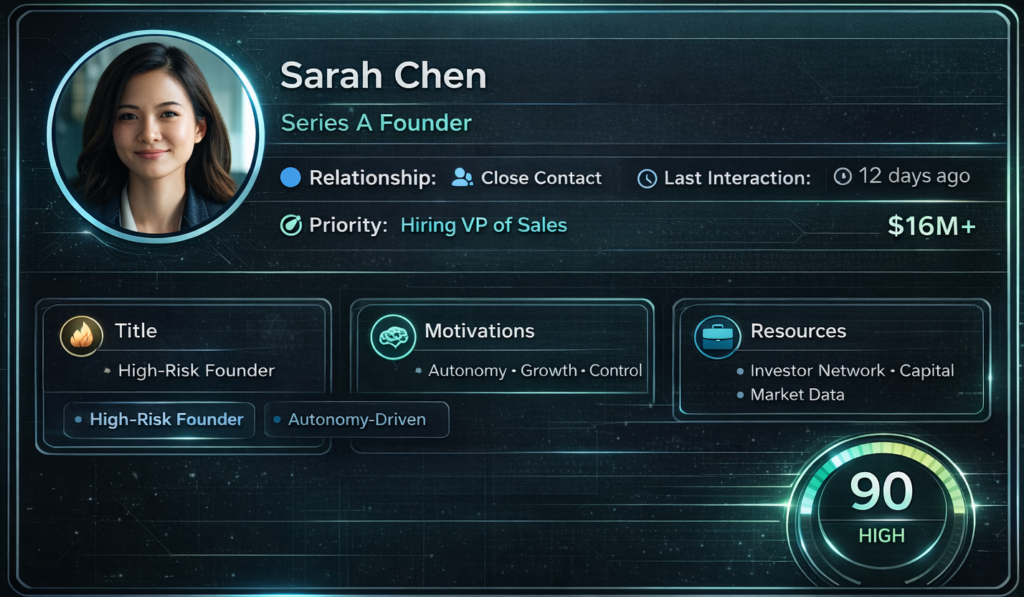
To win, you must feed the machine the “Social DNA” of the interaction.
If these four layers aren’t in your prompt, your message is Dead on Arrival:
- The Hidden Arsenal: What specialized capital—talent, data, distribution, or “unfair advantages”—do they control that you can strategically leverage?
- The Frequency: Do they want a 10-page whitepaper or a 2-word text?
- The North Star: What is the one thing keeping them awake at 2 AM right now?
- The Last Handshake: What was the final thing said before the silence?
From “Generic Garbage” to “Strategic Strike”
Avoid this:
Write a follow-up to Sarah.Use this instead:
Draft a follow-up to Sarah.

Relationship: peer operator I know well
Style: concise, direct, low-formality
Priority: hiring a VP of Sales
History: we spoke 12 days ago; she mentioned bandwidth issues
Goal: be useful, not generic
Constraint: 3 sentences max
The second prompt gives AI enough context to do something intelligent. It can match the tone to the relationship, reference the right issue, and make the message useful instead of forgettable. That is the shift: from asking AI to generate language to asking it to operate on context.
The winning use of AI in networking is not “write for me.” It is “help me remember, think, and show up well.”
Why “Doing It Yourself” is a Trap
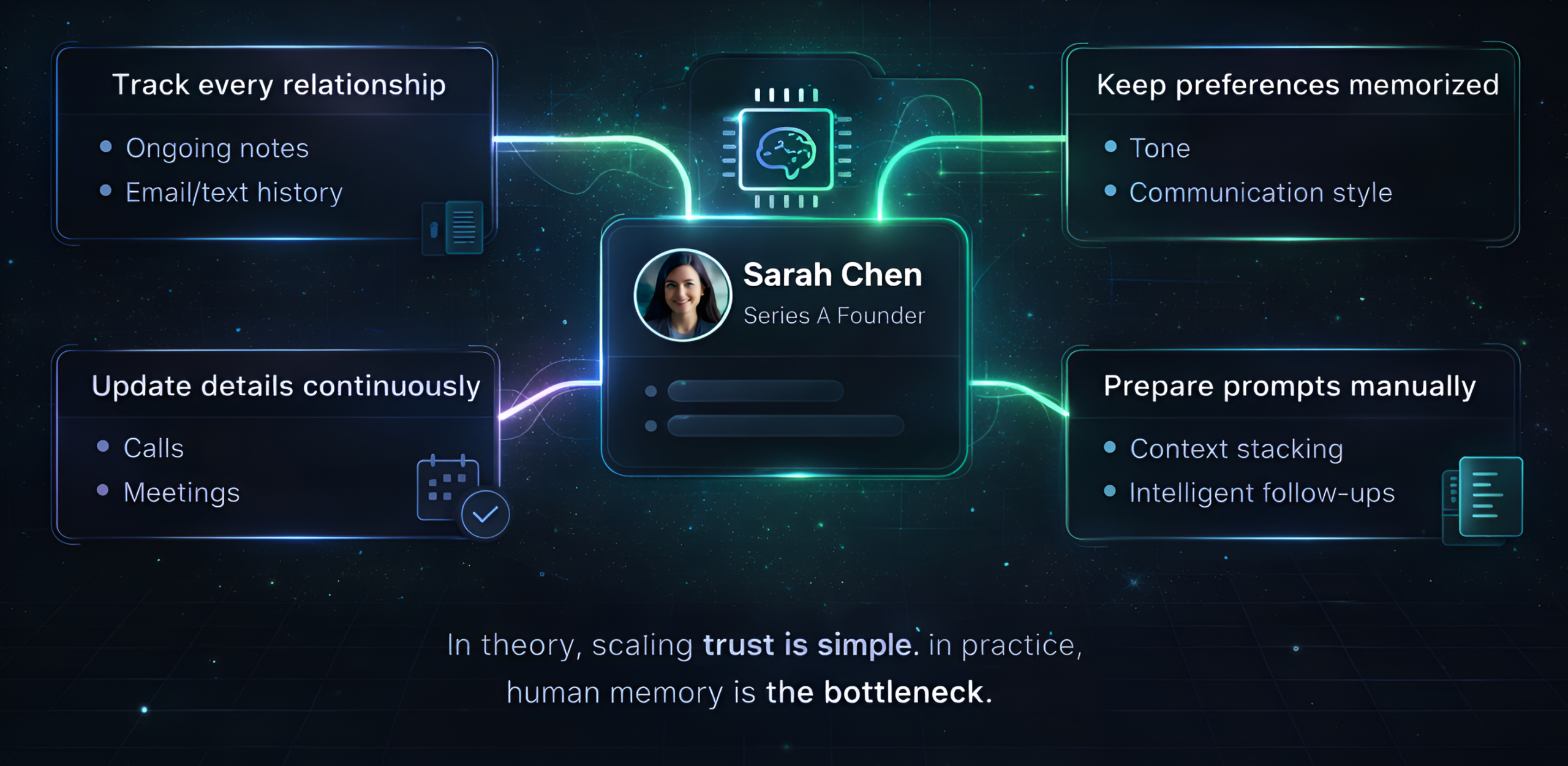
You can’t scale this manually. You can’t keep 500 “Social DNA” profiles in a spreadsheet without losing your mind. The moment you get busy, your system breaks. Your memory leaks. You fall back on “standard” prompts because you’re tired.
That is the exact moment you lose the room.
AchieveAI: The Living Memory Layer
AchieveAI was built to solve the Context Crisis. We don’t just give you a better “Compose” button. We give you a synthetic memory that lives on top of your network.
- Without AchieveAI: You are guessing. You are improvising. You are one “standard” email away from offending a key partner.
- With AchieveAI: Every message is backed by the full weight of your shared history.
Stop using AI to replace your voice. Start using it to amplify your impact.