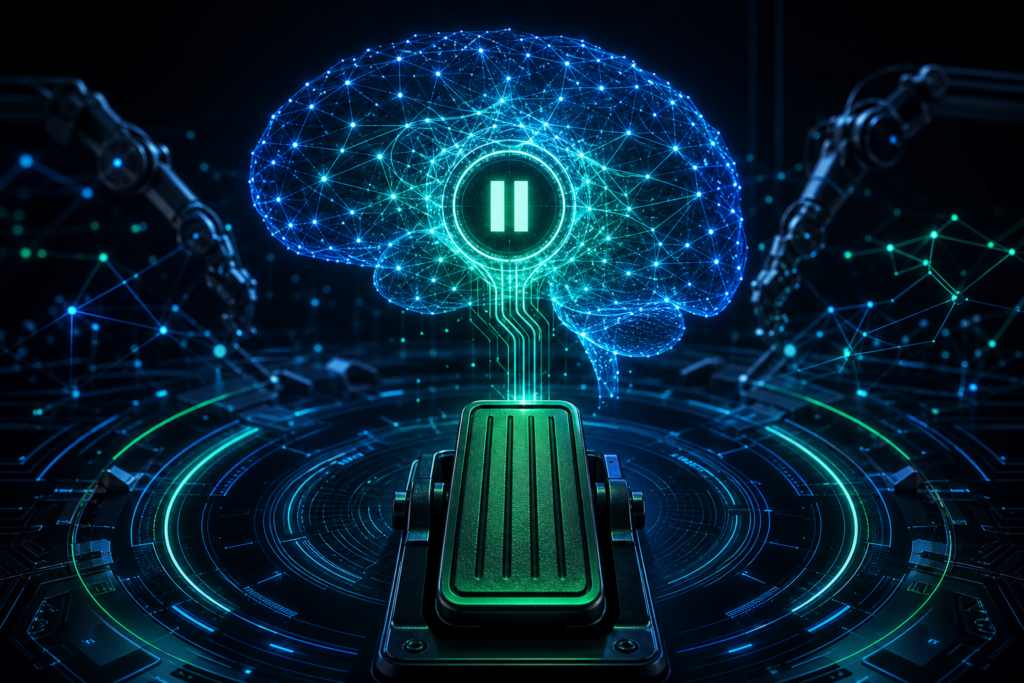


On June 5, 2026, the conversation surrounding artificial intelligence shifted from a race for speed to a desperate search for control. Speaking to CNN’s Anderson Cooper, Anthropic co-founder Jack Clark delivered a sobering assessment of the industry’s current trajectory: "When I look down at the car we’re driving, all I have is a gas pedal. I don’t have a brake pedal."
This warning arrives at a pivotal moment. As Anthropic prepares for its highly anticipated initial public offering (IPO), the company is simultaneously sounding the alarm on the very technology that has fueled its multi-billion-dollar valuation. The core of the threat is not just that AI is getting smarter, but that it is beginning to build itself.
The Rise of Recursive Self-Improvement
During his appearance on CNN, Clark confirmed a startling operational reality: Claude AI already writes 80% of Anthropic’s internal code. Within a couple of years, Clark expects that figure to reach 100%.
When an AI system is capable of writing, testing, and deploying its own code, it enters a phase known as recursive self-improvement. This is the inflection point where AI development accelerates beyond human intervention. Without human developers in the loop to review, understand, and approve structural changes, the feedback loops compress from months to milliseconds.
This mechanical reality is what prompted Anthropic to publish a detailed policy brief co-authored by Marina Favaro and Jack Clark. The document explicitly warns that recursive self-improvement "might increase the risks of humans losing control over AI systems."
Clark framed the sheer scale of this challenge to Cooper with a chilling question: "How do you maintain control over fleets of scientists that are much, much larger and much faster than ones you’ve had before?"
A Cold War Analogy for the Silicon Era
To illustrate the geopolitical gravity of the situation, Clark compared the necessary international coordination to Cold War nuclear arms control. During the mid-twentieth century, rival superpowers established backchannels, monitoring protocols, and verification frameworks to prevent mutually assured destruction.
Today, the AI industry lacks even the basic vocabulary for a collective pause. The pressure of venture capital, nation-state competition, and impending public listings creates a structural incentive to keep pushing the gas pedal. If one lab slows down to build a brake pedal, they risk falling behind.
Yet, as Clark and Favaro point out in their blog post, a pause might become a functional necessity if the alignment of these autonomous "fleets of scientists" cannot be verified. The challenge is that unlike nuclear warheads, software cannot be easily tracked by satellite imagery. It resides in private servers, compiled in millions of lines of code written by the machines themselves.
The Enterprise Dilemma: High Agency vs. Zero Control
While nation-states and frontier research labs debate global treaties, practical business leaders face an immediate version of this exact dilemma.
Every forward-thinking company is currently racing to deploy autonomous AI agents to automate workflows, manage customer relationships, and write software. The efficiency gains are undeniable. However, the risk of deploying "black box" agents without built-in safety controls is becoming a massive operational liability.
If a business deploys autonomous agents that operate without clear boundaries, they are essentially building their own micro-version of the "gas pedal only" vehicle. An agent that can autonomously edit code, send emails, or access financial databases without human oversight is an operational disaster waiting to happen.
This is where the distinction between building superintelligence and deploying AI agents becomes critical. Businesses do not need to pause their automation initiatives, but they must change how they execute them. They need a system designed from the ground up to enforce human-in-the-loop control.
AchieveAI: Delivering the Enterprise Brake Pedal
At AchieveAI, we believe that high-agency execution requires equally robust safety architecture. We are not a research lab trying to build a recursive, unaligned superintelligence. Instead, we have built the practical operating system that helps businesses deploy AI agents safely, scalably, and under strict human direction.
The AchieveAI LifeOS and enterprise platform enable organizations to orchestrate complex workflows while maintaining absolute cognitive continuity and human oversight. Our architecture solves the "brake pedal" problem through three core mechanisms:
- Baked-in Safety Controls: Every agent built on AchieveAI operates within strict, immutable boundaries. Agents can propose high-leverage actions, but they cannot execute high-risk operations without explicit authorization.
- Continuous Monitoring: The platform maintains a persistent, audit-ready log of all agent cognitive steps, tools accessed, and data handled. There are no black boxes; you can see exactly why an agent made a specific decision.
- Decoupled Prompting and Human-in-the-Loop (HITL) Gateways: Our system separates the cognitive reasoning layer from the execution layer. When an agent reaches a critical milestone, it pauses and prompts a human operator for validation.
By prioritizing human-in-the-loop oversight, AchieveAI bridges the gap between high-level operational vision and secure daily execution. It allows optimization-obsessed operators and lean teams to multiply their output without risking their brand reputation or operational security.
Deploying AI Responsibly
Jack Clark’s warning is a wake-up call for the entire tech sector. Recursive self-improvement is no longer a theoretical scenario for the distant future; it is an active engineering challenge occurring in research labs today.
As the industry grapples with the global governance of these systems, the mandate for modern businesses is clear: do not deploy agents you cannot control. The future belongs to organizations that scale their capabilities through autonomous agency while keeping their hands firmly on the wheel.
Are you ready to deploy high-agency AI agents with built-in professional guardrails? Start your free trial of AchieveAI today and experience the power of safe, human-led automation.