

State-Dependent Learning with AI: How to Trigger Peak Performance on Demand
Modern performance isn’t just about what you know — it’s about the state you’re in when you access that knowledge. Athletes, musicians, entrepreneurs, and elite performers across fields rely on state-dependent learning: the idea that memory and skill expression are tightly coupled with your physiological and psychological state. The missing piece? A scalable system to reliably trigger those states when you need them.
In this article you’ll learn how AI can detect, model, and trigger peak performance states—on demand—so your best work becomes repeatable instead of accidental. We’ll show why traditional practice falls short, the neuroscience behind state-dependent learning, and how AchieveAI operationalizes this into a real workflow you can use today.
Why practice alone isn’t enough
Most training focuses on repetition and feedback. But repetition in a single context doesn’t guarantee transfer. If you learn a presentation while tired and anxious, you’ll likely retrieve that memory best when you’re tired and anxious. That’s state-dependent memory: recall is optimized when encoding and retrieval states match.
For high-performers this creates a paradox: you train hard but your “best” session is rare. The solution is not more hours; it’s targeted state engineering—learning to enter the same cognitive, physiological, and emotional states that maximize performance.
The neuroscience: what state-dependent learning actually is
State-dependent learning relies on neural patterns—synchronized firing, hormonal profiles, heart rate variability, breathing patterns, and contextual cues. These signals act as retrieval keys. When matched during recall, they make access to practiced skills and memories far easier. The challenge is reliably recreating those signals across different situations.
That’s where measurement and precision matter. A handful of physiological markers (HRV, breath cadence, pupil dilation) combined with behavioral data (speech tempo, micro-expressions) produce a robust fingerprint of a target performance state.
Why AI is the missing lever
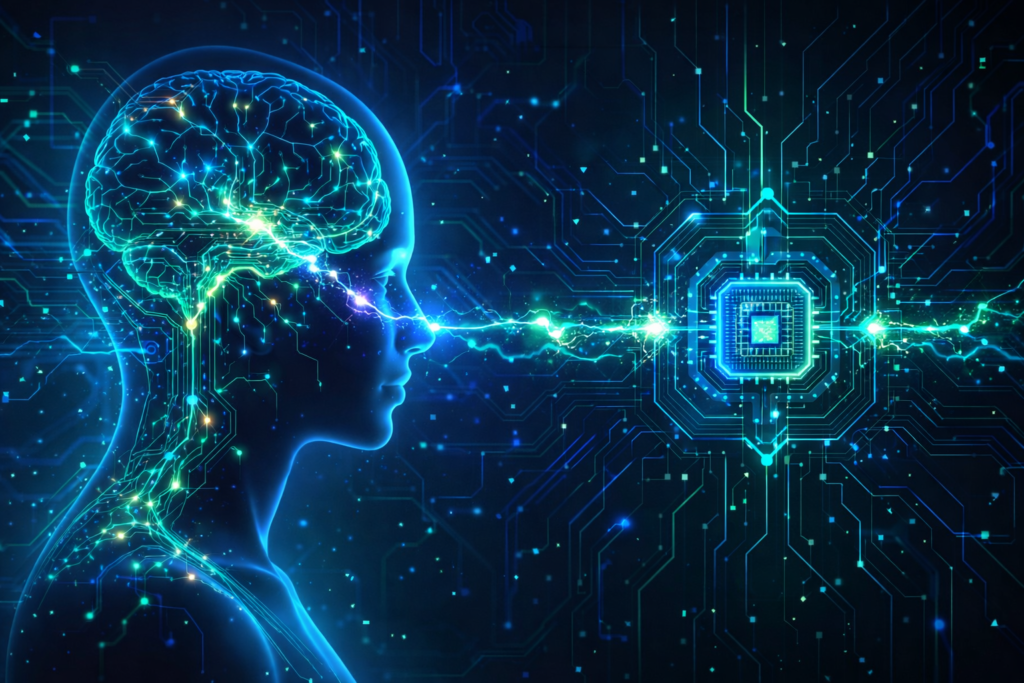
AI excels at pattern detection across noisy, multimodal data. By ingesting your wearable signals, session recordings, environmental context, and subjective ratings, machine learning models can identify the combination of factors that predict your peak states.
Then, using predictive models, the system can generate a personalized protocol to recreate those states: an exact breathing rhythm, a playlist of anchor tracks, an energizing micro-routine, or a visual cue sequence. Over time the model refines itself—becoming as good as a human coach, but faster and available 24/7.
How AchieveAI operationalizes state-dependent learning
AchieveAI combines sensors, behavioral inputs, and an adaptive AI loop to make state-dependent learning practical:
- Fingerprinting: During practice sessions, AchieveAI collects physiological (HRV, heart rate), contextual (time of day, environment), and performance data (task success, subjective clarity) to build a state fingerprint.
- Modeling: ML models find the minimal set of signals that predict peak performance for you—no generic templates. This includes breathing cadence, pre-performance rituals, and environmental cues.
- Triggering: When you need to perform, AchieveAI generates and executes a protocol: guided breathing, neural entrainment audio, lighting cues, and a short micro-practice to bring your system into the target state.
- Feedback loop: Every performance is logged and scored. The AI updates the fingerprint and protocol dynamically so your triggers evolve with your body and goals.
Real-world results (what to expect)
Users report more consistent high-quality performances, faster learning curves, and lower performance anxiety. Instead of hoping for a lucky day, you’ll create repeatable pre-performance routines that reliably access your best work. For founders and sales leaders, that looks like consistently sharp pitches and decisive negotiations. For athletes, it’s on-demand physical readiness. For creators, it’s flow-state consistency.
Getting started: a simple protocol you can try today
- Record three practice sessions of your target task with heart-rate and subjective clarity ratings.
- Use guided 3:6 breathing (3 seconds inhale, 6 seconds exhale) for 60 seconds, then perform.
- Note which session felt best and let AchieveAI fingerprint the pattern.
- Use the generated micro-protocol (audio cue, breathing, 30-second warmup) before important performance windows.
These steps alone will increase the repeatability of your peak states. With AchieveAI, the process is automated: the model learns your unique state signature and delivers the exact triggers when you need them.
Conclusion — make your best work reproducible
State-dependent learning flips the equation from hoping you’ll be “in the zone” to knowing how to get there. AI gives you the measurement, modeling, and personalized triggers required to turn rare peak sessions into reliable outcomes. If you care about consistent high performance, state engineering—enabled by AI—is the next frontier.
Try AchieveAI’s state-dependent learning workflow today: start a free trial and attach your first three practice sessions. If you found this useful, share the article or leave a comment with the task you want to master—I’ll show you a 4-step micro-protocol to start.