


You have 12 browser tabs open. One for your habit tracker, one for your calendar, one for your notes, another for the app you downloaded last week that promises to fix your morning routine. You are not undisciplined. You are over-automated and under-aligned.
The problem is not that you lack willpower. The problem is that you are trying to adopt behaviors without becoming the kind of person who naturally does them.
Lose 20 pounds is an outcome. I am an athlete is an identity. Write a book is a goal. I am a writer is a vote. The difference between people who sustain change and people who white-knuckle it for three weeks is not motivation. It is which layer of change they target.
Why Outcome-Based Habits Fail for Ambitious People
Outcome-based habit formation sounds logical. Set a target. Reverse-engineer the steps. Execute. The problem is that outcomes live in the future, and the future has no leverage over who you are right now.
When your identity says I am someone who scrambles before deadlines, every productivity hack you stack on top becomes friction against your self-image. You are not building habits. You are arguing with yourself. And you will lose that argument every time, because identity is the deepest operating system running your behavior.
Behavior change research confirms this. People who framed exercise as becoming an active person stuck with it at significantly higher rates than those who framed it as losing weight. The action was identical. The identity it served was different. And identity won.
The Identity-First Framework for Habit Formation
Here is the framework. Not motivational fluff. A four-layer system for becoming who you want to be through the habits you execute daily.
Layer 1: Decide the Person You Want to Become
Not what you want to have. Not what you want to achieve. Who you want to be.
Get specific. Not I want to be successful. Instead: I am a founder who executes before breakfast. I am a creator who publishes weekly. I am an operator who follows up within 24 hours.
Write it down in the first person, present tense. This is not affirmation theater. This is a declaration that every subsequent habit either supports or contradicts. Once you name the identity, you have a filter for every decision. Does this action vote for that person or against them?
This is the move most people skip because it feels too simple. That is exactly why they stay stuck.
Layer 2: Prove It to Yourself with Small Wins
Identity does not change because you declared it. Identity changes because you demonstrated it. Repeatedly.
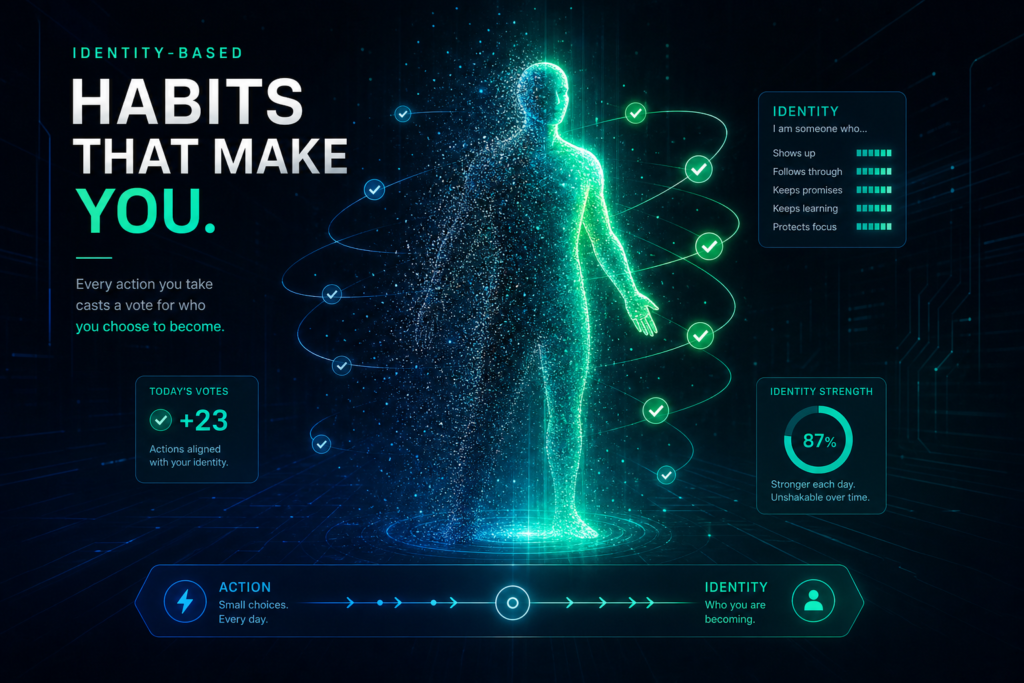
The mechanism is what James Clear calls evidence. Every small action you take that aligns with your chosen identity deposits proof into your self-concept. One workout does not make you an athlete. But it is a vote. Ten votes in a row? You start to believe it. Twenty votes? It becomes harder to contradict.
The key insight for habit formation: start embarrassingly small. Not because you are incapable of more, but because you need volume of proof, not intensity of effort. Send one follow-up message today. Write 200 words before lunch. Review your pipeline for 10 minutes. The size of the action matters less than the consistency of the vote.
Layer 3: Stack Habits onto Your New Identity
Once the identity is established and small wins are building evidence, you stack.
Stacking means attaching new behaviors to the identity you are constructing, not to external triggers alone. Instead of after I pour coffee, I will review my goals, try because I am an operator who starts every day with clarity, I review my priorities first.
The difference is subtle but structurally important. External triggers break when context changes. Identity-based triggers travel with you. When your habit is anchored to who you are, it survives disrupted routines, travel, stress, and chaos. Because you do not lose your identity when the environment shifts. You carry it.
For ambitious entrepreneurs managing multiple ventures, this is the only sustainable architecture. Your calendar will not always hold. Your morning routine will get interrupted. But your identity persists.
Layer 4: Use Environment Design to Make the Identity Easy
Willpower is a terrible long-term strategy. Environment design is a superior one.
If your identity is I am someone who creates daily, but your laptop has 47 distracting bookmarks and your phone lights up with notifications every 90 seconds, your environment is voting against your identity. You are fighting your own infrastructure.
Environment design means engineering your surroundings so the identity-aligned action is the path of least resistance. Remove friction from the behaviors you want. Add friction to the ones you want to eliminate.
This applies to digital environments too. If you are tracking habits, goals, and priorities across five different apps, you have built an environment of fragmentation. The tool itself is contradicting your identity as someone who operates with clarity and leverage.
Why This Matters for High-Performing Operators
Most productivity advice targets behavior. Do this. Stop doing that. Here is your morning routine. Here is your evening checklist. It treats you like a machine that needs better programming.
But you are not a machine. You are an identity with execution habits attached. And the operators who compound results over years are the ones who understand this distinction. They do not just manage tasks. They manage who they are becoming.
Every client meeting, every follow-up, every content piece, every strategic decision is a vote. Over months, those votes accumulate into an identity that produces results automatically. Not because the work is easy. Because the person doing it has become the kind of person for whom that work is natural.
Tracking the System: From Identity to Execution
Deciding the identity is the strategic layer. Proving it with small wins is the tactical layer. Stacking and environment design are the operational layers. But none of it compounds if you cannot see it.
You need a system that holds your identity declarations, tracks your habit votes, and shows you the pattern over time. Not another app. A unified operating system that connects who you are becoming to what you actually do daily.
This is exactly what AchieveAI’s Life OS is built for. When your habits, goals, relationships, and execution live in one cognitive layer instead of scattered across twelve tabs, something shifts. You stop managing tools and start managing identity.
Your PSI tracks what you committed to. It notices when your behavior contradicts your stated identity. It surfaces the pattern so you can correct it before three weeks of drift turn into another abandoned system.
The Vote Counts Now
You are already becoming someone through the habits you execute today. The question is whether that person is the one you chose or the default version that drifts on autopilot.
Decide who you want to become. Start proving it today. Stack every action onto that identity. Design your environment so the person you are becoming is the easiest person to be.
Then let a system that thinks with you track the votes, hold the context, and surface the drift. Because identity-based habit formation is not a one-time exercise. It is a daily practice of becoming who you act like.
Ready to build an operating system around the identity you are constructing? Start with AchieveAI and turn your highest vision into your daily operating reality.