
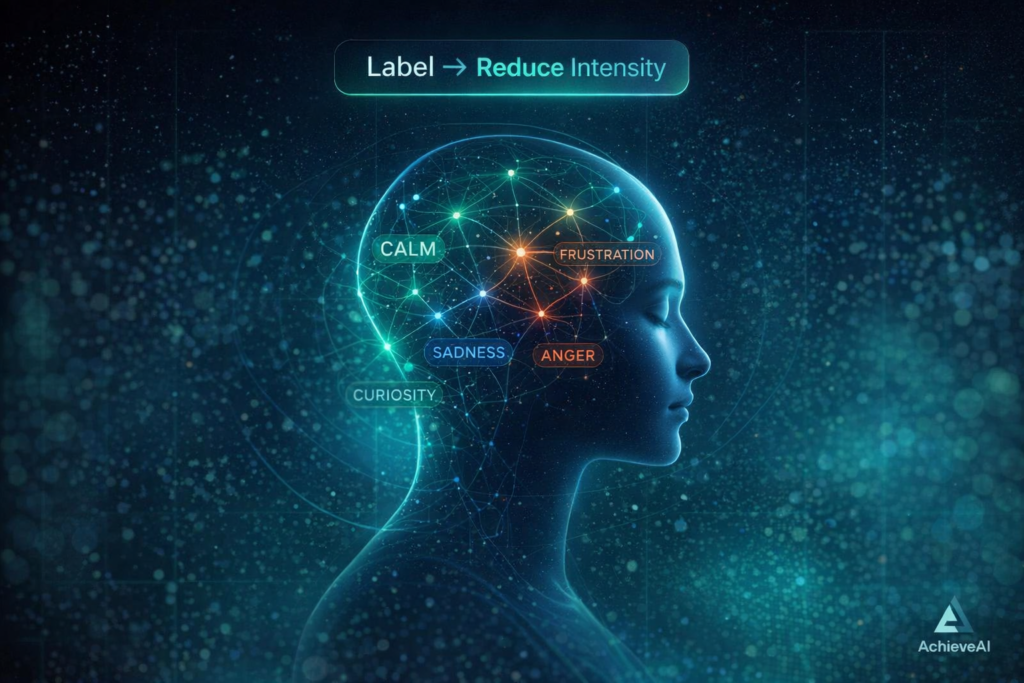


Emotions are not fixed. They are evaluations, fast computations your brain performs about what’s happening and what it means for you. Cognitive Appraisal Theory reframes emotions as judgments. When you can label those judgments precisely, you shrink their power. That’s where AchieveAI steps in—bridging cognitive science with real-time assistance to help you notice, label, and reduce emotional intensity so you can act with clarity.
What is Cognitive Appraisal Theory?
Cognitive Appraisal Theory, developed in the psychological literature, suggests that emotions arise from how we evaluate events relative to our goals, values, and expectations. It’s not the event itself but the interpretation of it that triggers feelings. For leaders, founders, and high-performance operators, those interpretations can hijack decision-making. A late investor reply becomes a perceived slight, and suddenly you’re defensive instead of strategic.
Why labeling matters
Labeling an emotion creates a gap between stimulus and reaction. That gap is your control point. Neuroscience shows that putting feelings into words activates the prefrontal cortex and reduces amygdala reactivity. In plain terms: naming what you feel lessens how intensely you feel it, enabling better decisions.
Where human limits break down
People fail to label emotions accurately for several reasons: speed of experience, lack of vocabulary, and confirmation bias. When you’re operating at high tempo, you default to coarse labels like “upset” or “angry.” Those labels are blunt instruments. The difference between “mild irritation about timing” and “fear of appearing incompetent” changes how you act.
AI as a cognitive partner
That’s where an AI like AchieveAI becomes a force multiplier. AchieveAI watches language, behavior patterns, and context to suggest more precise appraisals in real time. It doesn’t replace your judgment. It widens the gap. By suggesting refined labels—like “anticipatory anxiety” instead of “stress”—it reduces intensity and gives you space to choose a response aligned with your goals.
How AchieveAI applies appraisal labeling
- Context synthesis. AchieveAI aggregates signals from messages, calendar events, and recent interactions to propose appraisals anchored in facts, not stories.
- Emotion vocabulary scaffolding. The system suggests targeted labels and short descriptors so your internal narrative becomes precise, not fuzzy.
- Behavioral nudges. After labeling, AchieveAI recommends a micro-action—breathe, pause reply, schedule a 5 minute reflection—that breaks reactivity loops.
- Learning loop. Over time AchieveAI calibrates to how your appraisals map to real outcomes, sharpening accuracy and usefulness.
Practical example
Imagine you get an email from a cofounder: “We need to talk about priorities.” Your instant reaction might be alarm. AchieveAI surfaces possible appraisals: “perceived blame” vs “boundary setting” vs “resource constraint.” It nudges you to label, then recommends a one-sentence reply that buys time and clarifies facts. You move from reactive to strategic.
Why this matters for leaders
Leaders are judged by decisions made under pressure. Reducing emotional intensity isn’t about being colder; it’s about making decisions that match your highest leverage. AchieveAI’s appraisal layer preserves momentum while preventing costly reactivity that damages relationships or deals.
How to start
Start by building a simple habit: when you feel a strong reaction, ask yourself “What is this reaction telling me about my goals or threats?” Use AchieveAI to surface candidate labels, pick the one that fits, and take a micro-action recommended by the system. Over weeks, you’ll notice fewer impulsive replies and clearer judgment calls.
AchieveAI is designed to be your cognitive partner. It notices the patterns you miss and gives you the vocabulary to interrupt emotional escalation before it costs you time, deals, or relationships.
Try AchieveAI free for 14 days and see how better labeling changes your decisions. If this article helped, share it or leave a comment with a reaction you labeled today.