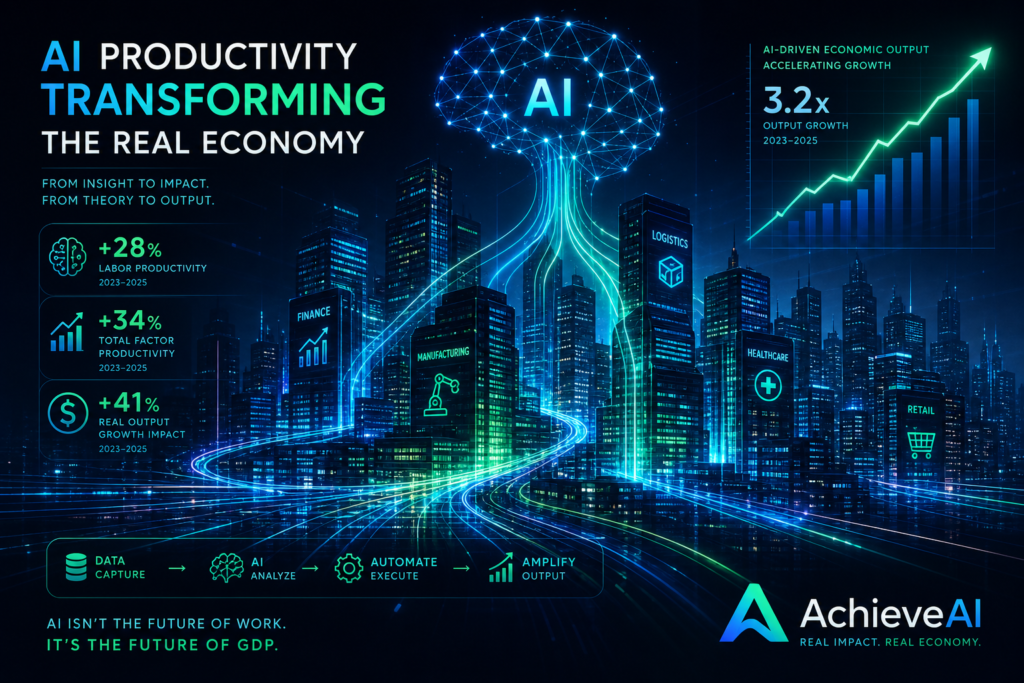


While theoretical debates about whether artificial intelligence is an overhyped bubble dominate the headlines, the ground reality has already shifted. The macroeconomic data has arrived, and it points to a silent, bottom-up takeover of the American labor market.
According to a landmark analysis from the Federal Reserve Bank of St. Louis, generative AI adoption is not just accelerating: it is rewriting the rules of business productivity at a pace that makes the early internet look slow. The data is clear. The productivity gains are no longer speculative. They are showing up in the real economy right now.
The St. Louis Fed AI Data: A Historical Outlier
For years, skeptics pointed to the "productivity paradox," asking why massive investments in technology were not showing up in GDP or labor reports. The St. Louis Fed report, titled "State of Generative AI Adoption" and published in late 2025, puts that skepticism to rest.
By August 2025, a staggering 54.6 percent of working-age Americans were using generative AI, up from 44.6 percent just a year prior. When you narrow the focus to the workplace, the trend is even more pronounced. Active work use of AI rose from 33.3 percent to 37.4 percent in the same period.
To put this in perspective, this adoption curve is far ahead of the personal computer and the early internet at comparable stages of their life cycles. We are witnessing the fastest technological integration in human history. But the real story lies in what happens when workers log in.
The Silent Hours Recovered
What are these workers actually achieving? On average, generative AI users are saving 5.4 percent of their work hours. That might sound modest on paper, but in macroeconomic terms, it is a massive shock. More importantly, the distribution of those savings is highly concentrated among high performers. More than one in five users (20.5 percent) are saving four or more hours per week. That is a full half-day of work reclaimed every single week.
Cumulatively, researchers estimate that generative AI has already delivered a 1.3 percent boost to US labor productivity since ChatGPT was first released. When we look at specific developer and operational benchmarks, the micro-level numbers are even more aggressive:
- Engineering: Organizations using GitHub Copilot are seeing 26 percent more pull requests completed.
- Customer Operations: Standard support desks are resolving 14 percent more issues per hour.
- Macro Projections: McKinsey estimates that AI automation could add between 0.1 and 0.6 percentage points to annual productivity growth globally over the coming decades.
The Ghost in the Corporate Machine
Yet, if you look at how most enterprises operate, you would never know this revolution is underway. There is a massive, structural disconnect between how workers use these tools and how companies manage them.
The St. Louis Fed and industry trackers highlight a fascinating, slightly chaotic trend: "Bring Your Own AI." Nearly half of all US workers using AI in the workplace do so without ever telling their employers.
Why? Because leadership is too slow.
While executive boards hold endless meetings about "AI risk assessment" and draft restrictive policies, the actual builders and operators on the ground are quietly using these models to destroy their manual backlogs. They are keeping the time savings for themselves, using the extra hours to relieve cognitive burnout, take on side projects, or simply look like superstars while working half as much. This is a massive organizational failure. When half your workforce is using fragmented, disconnected tools under the table, you do not have an AI strategy. You have a shadow IT liability and a massive pool of wasted leverage.
The 60% Execution Gap
The data exposes a gaping vulnerability: 60 percent of business leaders admit their organization completely lacks a clear plan for AI integration. They are treating generative AI as a toy, an intellectual novelty, or a slightly better search engine. They buy a few dozen ChatGPT Plus licenses, hand them out to employees, and expect magic to happen.
But individual hacks do not build enterprise value. If your AI strategy relies on single employees copy-pasting text back and forth between a browser tab and a spreadsheet, you are leaving 90 percent of the value on the table. You are still running a manual business; you have just outsourced the typing. The winners of the next decade will not be the companies that merely tolerate AI. The winners will be those who systematize AI into their core operational infrastructure.
Systematizing the Cognitive Layer
To turn individual productivity into organizational leverage, you must transition from passive generative AI adoption to autonomous AI automation. You need to stop asking your humans to act as the glue between your databases and your AI prompts.
This is exactly why we built AchieveAI.
AchieveAI is designed as a Personal Super Intelligence (PSI) and Life Operating System (LifeOS) that bridges this exact structural gap. Instead of forcing you or your team to manage a dozen separate tools, AchieveAI unifies vision, relationships, tasks, and system operations into a single, cohesive cognitive layer.
By utilizing Infinite Memory and Cognitive Continuity, AchieveAI acts as a digital Chief of Staff. It does not wait for a prompt to act. It remembers what matters, bridges cross-tool contexts, and autonomously completes the high-leverage tasks that keep your operations moving: scheduling, automatic follow-ups, database syncing, and client outreach.
For high-net-worth operators, founders, and lean, high-growth teams, this is how you close the execution gap. You stop treating AI as a browser-tab distraction and start treating it as your autonomous operational backbone. The productivity revolution is already here, and it is showing up in the Federal Reserve’s hard data. The only question left is whether you will let your team use it to hide, or whether you will systematize it to scale.