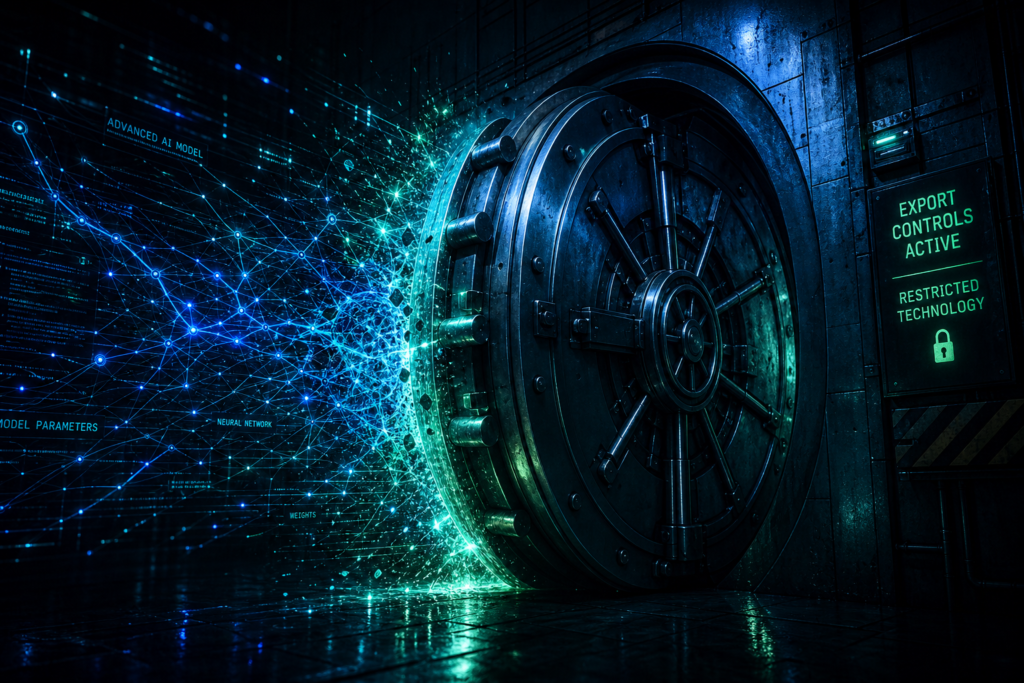


Last Friday, a U.S. government agency shut down one of the world’s most advanced AI systems. Not a bug. Not a hack. Not a technical failure. A policy decision.
Anthropic’s Fable 5 and Mythos 5 models were suddenly restricted under new export controls imposed by the Trump administration. The shutdown was triggered by Amazon CEO Andy Jassy raising the alarm about a jailbreak vulnerability in the models. What followed was a cascade: Anthropic halted global access, foreign nationals were barred from using the systems, and the company scrambled to dispatch staff to Washington.
This isn’t a niche AI story. It’s a warning shot for every business building on AI infrastructure.
Here’s what actually happened.
On Friday, the Department of Commerce imposed export controls on Anthropic’s newest and most capable models. The move came after Amazon, a major Anthropic investor and partner, identified a security flaw that could allow the models to be manipulated beyond their intended safeguards. According to reports from Reuters and the Wall Street Journal, Amazon voiced concerns that Anthropic had not adequately addressed the vulnerability.
The administration acted fast. Within 24 hours, according to Politico’s reporting, export controls were in place. Axios confirmed that foreign access was blocked. Fortune reported that Anthropic disabled Fable and Mythos globally to comply. Tom’s Hardware cited David Sacks, the administration’s AI and crypto czar, saying Anthropic had refused to fix the jailbreak when given the opportunity.
The result: a leading AI provider’s most advanced products went dark worldwide. Businesses, researchers, and developers who had built workflows around these models lost access overnight.
Why this matters for you.
If you’re a founder, agency owner, or solopreneur using AI tools for customer outreach, follow-ups, content, or any operational workflow, you just learned something uncomfortable: the tool you depend on can be switched off by a government order. Not because you did anything wrong. Not because the technology failed. Because of a policy disagreement between a corporation and a regulator.
This is the vendor dependency problem nobody wants to talk about.
Most AI-powered tools today run on centralized models from a handful of providers: OpenAI, Anthropic, Google, Meta. When you build your business processes on top of one of these models, you’re not just adopting technology. You’re adopting a single point of failure. A regulatory target. A geopolitical variable.
Anthropic isn’t some fly-by-night startup. It’s a well-funded, Silicon Valley-backed AI company with deep enterprise partnerships. And it still got shut down.
The overlooked lesson.
The lesson isn’t "be careful which AI you use." The lesson is that any AI system built on a single centralized model is inherently fragile. Export controls are just one threat vector. There are also API pricing changes, rate limits, model deprecations, terms of service updates, and simple platform outages.
Every one of these can break your business overnight if your entire operation depends on one provider’s infrastructure.
This is why the architecture matters more than the model. It’s not about which LLM is best this quarter. It’s about whether your system is designed to survive when any single component goes down.
Why decentralized AI operations are the only safe bet.
The future of AI isn’t a monopoly. It’s a distributed network of capabilities that can route around failures. The businesses that thrive will be the ones running on systems designed for continuity, not convenience.
That means multi-model orchestration. It means agent architectures that can switch providers without breaking workflows. It means owning your data, your context, and your cognitive layer instead of renting them from a company that might lose export privileges next quarter.
This isn’t theoretical. This is what happened last Friday.
If you’re building your business on AI follow-ups and customer outreach, you need a system that can’t be unplugged by a government order. AchieveAI runs on a distributed agent architecture designed for continuity. Start a free trial and see what happens when your AI actually works for you, not for a policy debate in Washington.