
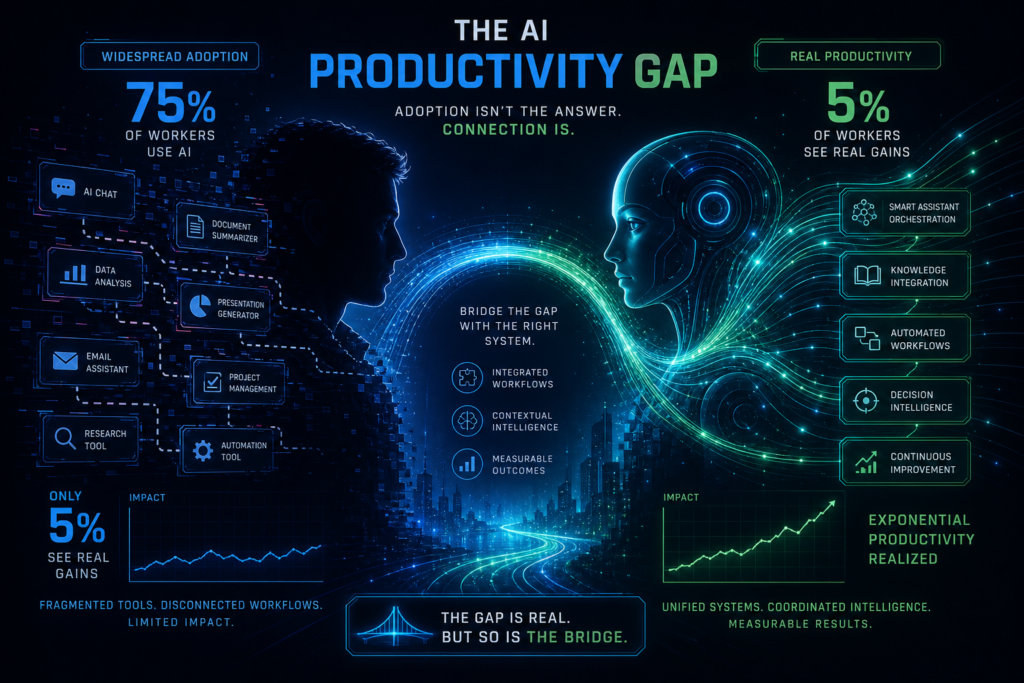


Today at the Work Innovation Summit in London, enterprise giant Asana pulled back the curtain on a quiet crisis plaguing the tech world. They call it the AI productivity gap.
According to their data, 75 percent of knowledge workers are now using AI on the job. Yet, a meager 5 percent of companies report seeing any meaningful productivity gains from it.
Think about that imbalance. We are living through the greatest technological gold rush since the dawn of the internet, but almost everyone is still digging with plastic spoons.
Asana diagnoses the problem with four distinct bottlenecks:
1. It is too hard to get started.
2. AI agents are not team players.
3. These agents completely lack context.
4. It is incredibly difficult to govern.
To solve this, Asana unveiled their new Operating System for Human-Agent Teams. It is an impressive enterprise play. But let us be entirely honest: it is built for the Fortune 500 boardroom. It is designed for companies with bloated org charts, endless deployment cycles, and massive administrative overhead.
If you are a founder, a high-ticket dealmaker, or a lean operator running a high-leverage business, that enterprise solution is not just useless, it is actively counterproductive. You do not need a multi-million-dollar corporate orchestration layer. You do not need another complex dashboard to configure.
You need an AI that already understands your business, your goals, and your immediate context. You need a system that works with you, not at you.
The Real Cause of the AI Productivity Gap
The reason most AI tools fail to move the needle is simple: they have no memory.
Every time you open a typical chat interface, you start from scratch. You have to explain who you are, what your business does, what your goals are, and how you like to operate. The moment you close the tab, that context is vaporized. This is not productivity; it is a recurring cognitive tax.
Enterprise platforms try to solve this by building massive, top-down data warehouses. But for an entrepreneur, that approach is too slow and too rigid.
Your business does not run on rigid database tables. It runs on momentum, relationships, and rapid execution. When you are moving fast, you cannot stop to train a corporate agent on your workflow. The system must adapt to you, preserving your cognitive continuity across every tool you use.
Enter the Personal Super Intelligence
This is exactly why we built AchieveAI. While giant software corporations build complex operating systems for enterprise committees, we built a Personal Super Intelligence (PSI) designed specifically for optimization-obsessed operators.
AchieveAI acts as your digital Chief of Staff, Digital CEO, and Personal Guide. Instead of treating AI as a series of disconnected, single-use text boxes, AchieveAI unifies your vision, relationships, work, and identity into a single, cohesive cognitive layer.
We solve Asana’s four bottlenecks directly:
- No setup friction: It works out of the box, aligning directly with your existing vision and goals without requiring an enterprise integration roadmap.
- True team integration: Instead of sitting isolated in a single app, AchieveAI works across your entire stack, preserving your context wherever you go.
- Infinite Memory: It remembers your relationships, your past decisions, and your strategic objectives. You never have to explain yourself twice.
- Autonomous Agency: It does not just suggest text; it takes action. From drafting follow-ups to managing CRM updates and coordinating real-world tasks, it completes the work so you do not have to.
Stop Configuring. Start Executing.
The $4 trillion opportunity in AI productivity will not be claimed by companies that spend the next two years configuring enterprise middleware. It will be won by the high-agency operators who deploy immediate, high-leverage solutions today.
If you are running a business with $1M to $10M in ARR, you do not have the luxury of waiting for enterprise IT to figure this out. You are already too large to handle every manual detail yourself, but too lean to hire an army of executive assistants.
You need the to-do list that actually completes itself. You need a system that preserves your focus, maintains your context, and executes your high-level vision without adding more administrative noise to your day.
The enterprise can keep its meetings about human-agent teams. We are busy executing.