
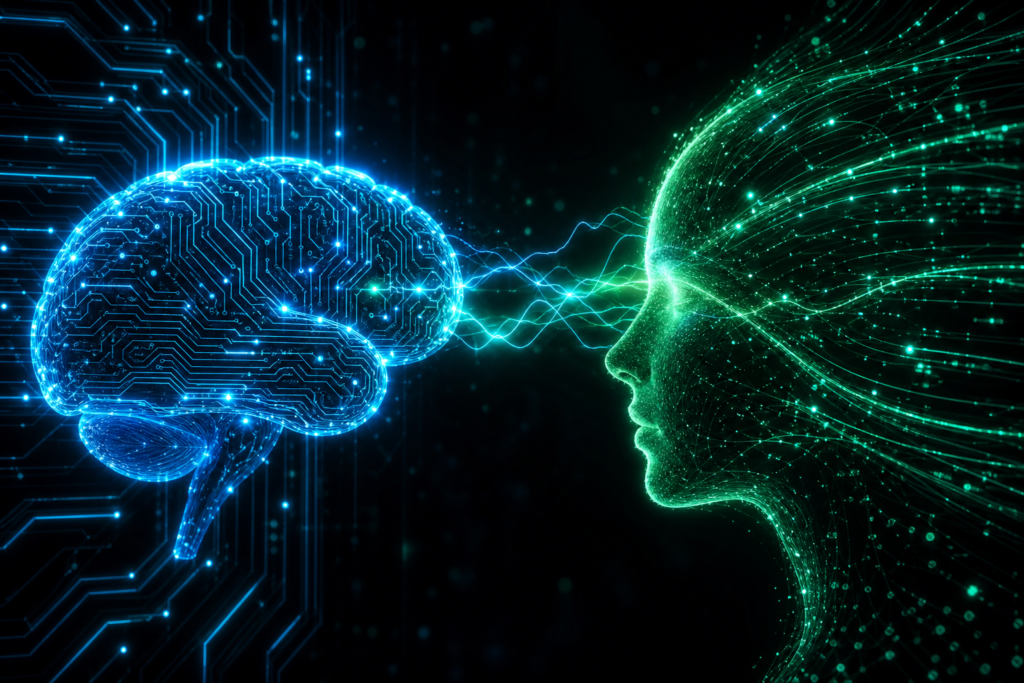


Can AI Really Learn Empathy? The Truth About Synthetic Empathy Training
The standard objection to artificial intelligence is always the same, tired lament: "But it does not have a soul." Hand-wringing critics love to insist that because machines do not feel, they cannot connect. They treat empathy as some mystical, biological miracle that only carbon-based lifeforms can trade in.
They are wrong. And the data proves it.
In a landmark study published in Nature, third-party evaluators were asked to rate responses to patient inquiries. The evaluators did not know which answers came from human doctors and which came from an AI. The result? The AI-generated responses were rated as significantly more compassionate, thorough, and responsive than those written by actual human physicians. It turns out that when humans are tired, overworked, or distracted, their empathy fails. The machine’s empathy, however, is a protocol. It does not sleep, it does not get irritated, and it does not run out of patience.
The era of synthetic empathy is here. It is not a cheap parlor trick, and it is not a threat to our humanity. It is a highly engineered, outcome-focused system designed to scale emotional validation. For high-agency founders, dealmakers, and operators, understanding how this technology works is no longer optional. It is the defining competitive advantage of the next decade.
What Is Synthetic Empathy?
To understand this shift, we must first strip away the romanticism. Synthetic empathy is protocol-driven emotional pattern recognition. It is not a felt biological experience. The AI does not feel a pang of sorrow when you share a setback, nor does it feel a rush of dopamine when you celebrate a win. It does not need to.
Instead, systems of AI emotional intelligence detect human emotional states by analyzing clear, objective data streams:
- Vocal Tone and Prosody: Measuring pitch variation, speech rate, and micro-tremors in real-time audio.
- Word Choice and Syntax: Identifying linguistic shifts, such as an increase in passive voice or the sudden use of highly defensive vocabulary.
- Sentiment Analysis: Evaluating the emotional weight of phrases against massive contextual libraries.
- Behavioral Data: Tracking response latency, typing speed, and navigation patterns to infer frustration or urgency.
Once the emotional state is mapped, the AI generates a calibrated response optimized for the specific human receiving it. It bypasses the human limitations of mood, fatigue, and cognitive bias. The machine does not offer empathy because it feels; it offers empathy because it has analyzed the context and determined that validation is the most effective path to a successful resolution. It is a feedback loop, optimized for human-AI connection.
The Validation Problem: Is It Empathy If It Isn’t Felt?
This is where philosophers get stuck in the mud. They ask: "Is it real empathy if the machine is just executing code?"
For high-performance operators, this is a distraction. The only question that matters in the real world is: "Does the human on the receiving end feel understood?"
Validation is about the receiver, not the sender. If an investor, a customer, or a team member walks away from an interaction feeling heard, supported, and clear on their next steps, the objective has been achieved. The origin of the validation is irrelevant; the outcome of the validation is everything.
This is not just theory. An extensive 2025 study by the American Psychological Association (APA) on AI companions and digital relationships revealed that synthetic empathy is actively reshaping emotional connections. Users consistently reported feeling more supported and less judged by AI systems than by the humans in their immediate social circles. The reason is simple: humans judge. AI listens, cross-references with infinite memory, and validates without ego.
When you strip away the philosophical hand-wringing, empathy is a mechanism for reducing friction and building trust. If a machine can reduce that friction more consistently than a human can, then synthetic empathy is not just "real enough" – it is functionally superior.
How Synthetic Empathy Is Trained
Building an emotional intelligence engine is not about teaching a machine to care. It is about rigorous engineering and empathy training validation. The frameworks used to build these systems are highly structured and entirely metrics-driven:
- Reinforcement Learning from Human Feedback (RLHF): Empathy is trained by giving the AI feedback on its conversational paths. Humans rate responses based on clarity, tone, and emotional resonance. Over millions of iterations, the model learns which linguistic structures diffuse tension and which ones escalate it.
- Emotional Labeling Datasets: AI models are trained on massive corpuses of human interactions – customer service chats, therapy transcripts, sales calls – where emotional inflection points are labeled. The AI learns to match specific human inputs to the appropriate emotional counterweight.
- Sentiment-to-Response Mapping: Systems are programmed with dynamic guardrails. If the system detects a high-stress sentiment score from the user, it automatically adjusts its output constraints – slowing down its pacing, adopting a collaborative posture, and prioritizing reassurance over immediate technical lecturing.
- Continuous Validation Loops: Advanced platforms do not stop learning after deployment. They continuously measure the user’s emotional trajectory throughout an interaction. If the user’s sentiment score improves after an AI intervention, that path is reinforced. If the user becomes more frustrated, the system flags the failure and reroutes the protocol.
For a B2B audience, this means emotional intelligence is no longer an intangible soft skill. It is a software stack that can be audited, optimized, and scaled.
Why Synthetic Empathy Is a Business Superpower
In business, miscommunication is the ultimate tax. It slows down deals, kills customer retention, and creates internal friction. Simulating understanding at scale is not a gimmick – it is a operational superpower.
Consider how synthetic empathy transforms the key pillars of your organization:
- Sales and Dealmaking: High-ticket sales require deep trust. An AI layer trained in synthetic empathy can analyze a prospect’s communication history, detect their underlying anxieties, and guide sales teams to address those exact fears with surgical precision. It ensures the prospect always feels completely understood, driving conversion rates higher.
- Customer Success: The primary reason customers churn is not product failure; it is the feeling of neglect. An AI customer success engine equipped with emotional intelligence can handle thousands of angry tickets simultaneously, diffusing anger with perfect, unwearied empathy while instantly solving the underlying technical issue.
- Leadership and Culture: As organizations grow, leaders lose the ability to maintain deep personal connections with every team member. An internal cognitive layer can monitor sentiment, notice when an operator is burning out, and proactively prompt leaders with the exact context needed to intervene effectively.
When your business utilizes an empathy layer, you are no longer guessing how your market feels. You are measuring it, responding to it, and automating the follow-through. The question is never "is it real?" The only question that matters to your bottom line is "does it work?" And the answer is a resounding yes.
Synthetic Empathy Is a Force Multiplier
Synthetic empathy is not a replacement for human connection. It is the infrastructure that makes deep human connection possible at scale. By automating the mechanical, repetitive aspects of emotional validation, we free ourselves to focus on high-leverage relationships, strategic execution, and creative vision.
The leaders who resist this technology because of romantic notions of human exclusivity will find themselves outpaced by those who embrace it. The future belongs to the operators who leverage synthetic empathy to build the most loyal audiences, the most aligned teams, and the most resilient customer bases.
Stop guessing what your customers feel. Let AchieveAI remember, understand, and act. Start your free trial at achieveai.io